Hass Avocado Farming East Africa: The Complete Profit Guide | FarmSentry Blog | FarmSentry
Written by Claud Fields
June 29, 2026Jun 29, 2026
10 min read
Avocado
Hass Avocado Farming East Africa: The Complete Profit Guide
In short
Hass avocado farming in East Africa can earn over $3,000 per acre yearly. Get the altitude right, plant on mounds, hit dry matter standards, and get GLOBALG.A.P. certified. Those four things separate profitable farms from expensive mistakes.
Introduction
One mature avocado tree can produce up to 800 fruits a year. Across Kenya, Tanzania, Uganda, and Rwanda, avocados have become a serious cash crop. Kenya alone produced a record 694,000 metric tons in 2025 (USDA, 2026).
But here’s the hard truth. Many new farmers lose everything. They plant in the wrong soil. They skip soil tests. They sign export contracts and then sell to roadside brokers for quick cash. These mistakes are often permanent.
This guide helps you avoid them. You’ll learn how to pick the right site, stop root rot before it starts, hit export grades, beat the False Codling Moth, and earn premium prices.
Let’s get into it.
Why Is Hass Avocado Farming East Africa So Profitable Right Now?
Two buyer groups now compete hard for your fruit: fresh exporters and oil processors. That competition pushes farm-gate prices up, especially for quality fruit.
Kenya’s avocado oil processors jumped from just three in 2021 to over 70 in 2025 (USDA, 2026). Each plant needs 10,000 to 15,000 metric tons of fruit a year to run properly. Most operate well below that because supply can’t keep up.
📊 By the Numbers: Kenya exported 121,000 MT of fresh avocados in 2025. Tanzania exported 37,871 MT, and Uganda shipped 22,575 MT in 2024 (USDA, 2026).
🎯 Key Takeaway: Industrial demand will outpace farmer supply for years. That means strong competition at the farm gate and better prices for well-managed farms.
What Site Conditions Does Hass Avocado Need?
Hass needs medium to high altitude, mild temperatures, and well-drained soil. The ideal range is 1,000 to 2,100 meters above sea level, with 1,000 to 1,600 mm of rainfall and temperatures of 25°C to 28°C.
Avoid hot, humid lowlands. Below 500 meters, fruit stays small and gets rejected for export. Trees also catch more fungal disease there.
🔍 Definition: Caliber means the weight class of a fruit. European supermarkets pay best for Calibers 16, 18, and 20, which run 180g to 260g.
Your soil must be deep, loose, and slightly acidic. Aim for a pH of 5.5 to 6.5. Dig profile pits 1.5 meters deep before planting. Test both topsoil and subsoil at a lab.
⚠️ Common Mistake: Skipping soil tests. Soil below pH 5.5 triggers aluminum toxicity. That locks up phosphorus and calcium and stunts trees permanently.
How Do I Stop Phytophthora Root Rot?
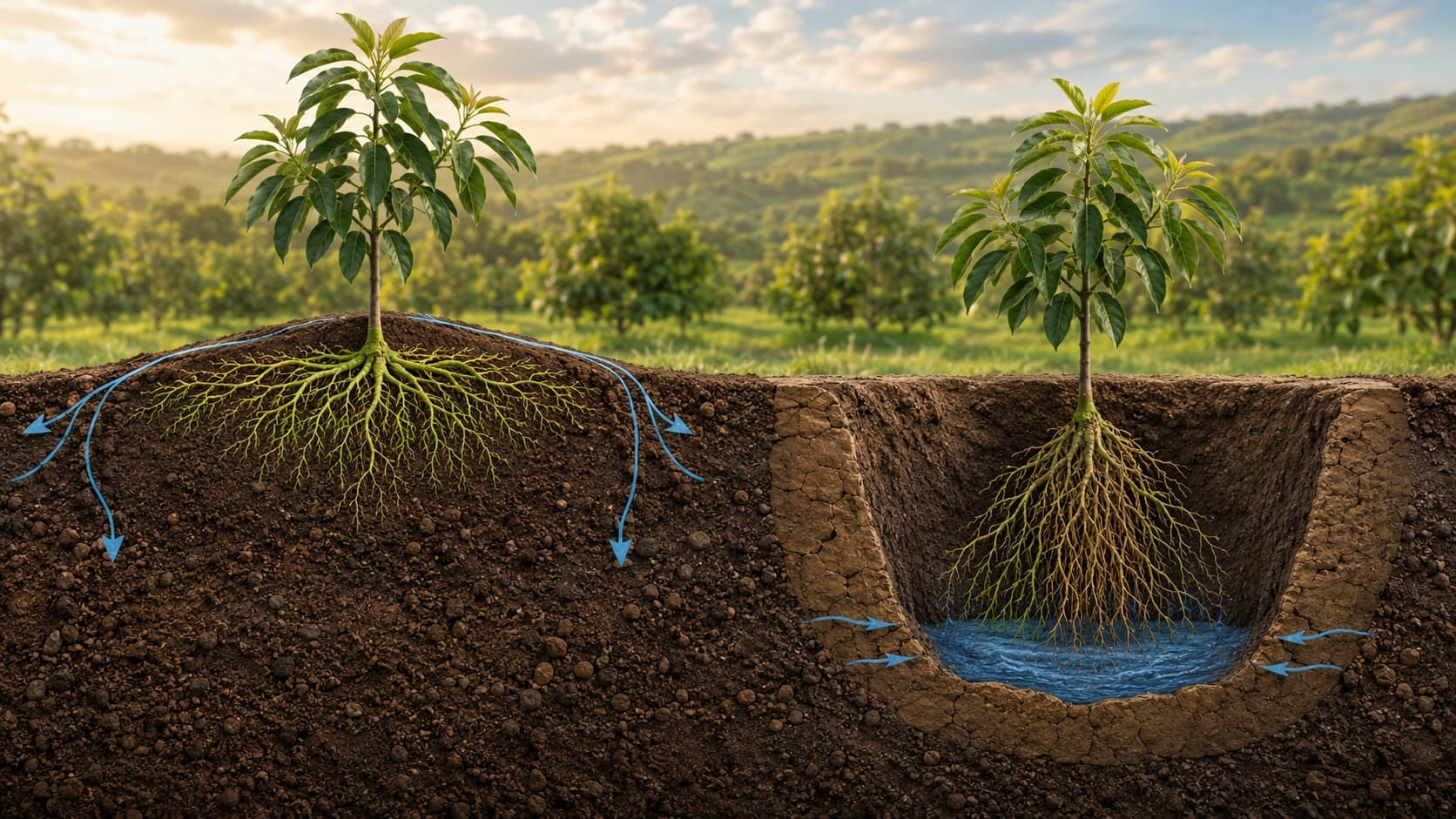
Plant on raised mounds, not in deep holes. Phytophthora cinnamomi is a water mold that kills avocado roots. It thrives in waterlogged, heavy clay soil. Mounding lets water drain away from the fragile root crown.
Avocado feeder roots are shallow and delicate. They sit in the top 20cm of soil. If roots stay in saturated soil for just 48 hours, the pathogen moves in and rots them.
✅ Best Practice: Build broad mounds 1.5 to 2 meters wide and 30 to 40cm high. Gravity does the drainage work, and your roots stay safe.
⚠️ Common Mistake: The “lazy hole” method. Digging a deep pit in clay and filling it with manure creates an underground bucket that traps water. It drowns your tree slowly.
Tracking soil prep and planting tasks across many trees is tough by hand. An activity logging tool lets you record mounding, drainage work, and irrigation per block so nothing gets missed.
Which Rootstock and Spacing Should I Choose?
Choose a clonal rootstock with strong root rot resistance, and space trees based on your region and management plan. Seed-grown trees don’t give reliable export quality. They also take up to ten years to fruit.
For East Africa, Dusa is the leading rootstock. It tolerates root rot and salinity well. It can outperform the older Duke 7 standard by up to 20% in yield (Westfalia Fruit, 2023).
Spacing differs by country:
Kenya: 5x5 meters, about 150 trees per acre. Needs heavy pruning to manage light.
Tanzania: 7x7 meters, about 82 trees per acre. Gives better airflow and room for intercrops.
💡 Pro Tip: Always interplant pollinator varieties like Ettinger, Fuerte, or Bacon. Orchards without cross-pollinators can lose up to 30% of their yield.
Grafted Hass trees give a small first harvest in Year 3. They reach break-even around Year 4 to 5. Peak yields of 8 to 12 tons per acre come in Year 7 and beyond.
What Makes Fruit Reach Export Grade One?
Export Grade One fruit must hit the right dry matter level, caliber size, and skin quality. Avocados mature on the tree but ripen after harvest. Pick too early, and the fruit won’t soften properly.
🔍 Definition: Dry matter (DM) is the percent of solid mass left after water is removed. It shows oil content and maturity.
Hass export needs a minimum of 24% dry matter. Packhouses test this by drying a fruit sample and weighing it. Fruit below 21% DM is rejected outright.
Aim for a 70% to 80% export pack-out rate. The skin must be free of insect damage, sunburn, and bruising. Decay has zero tolerance.
✅ Best Practice: Feed trees potassium-rich fertilizer like NPK 15:9:20 during fruit set and enlargement. This bulks up fruit to premium caliber sizes.
⚠️ Common Mistake: Harvesting early to chase processor cash. Premature fruit fails dry matter tests and destroys buyer trust fast.
How Do I Control the False Codling Moth Cheaply?
Use low-cost light and oil traps that won’t breach EU residue limits. The False Codling Moth (FCM) is the biggest threat to East African avocado exports. The EU enforces zero tolerance on this quarantine pest.
A single live FCM larva can get an entire shipping container rejected and destroyed. Repeat cases trigger national export bans (MDPI, 2024).
📊 By the Numbers: Farmers in Timau reported cutting FCM populations by about 60% using simple traps. They hang halved 20-liter containers filled with used engine oil under a night light. Moths fly in and suffocate.
Heavy chemical spraying isn’t the answer. Overspraying causes residue rejections that hurt just as much as the pest itself. Integrated Pest Management protects both your fruit and your market access.
Logging trap checks, pest counts, and treatments helps you catch problems early. A farm health and treatment tracker keeps a full record you can show buyers and auditors.
What Are the Real Costs and Returns?
Establishment costs run high, and you must survive three to four years before break-even. In Kenya, setting up one acre of high-density Hass costs about KES 180,000 to KES 350,000 ($1,389 to $2,702). Drip irrigation is the biggest variable.
Annual operating cost for a mature Kenyan farm averages around KES 80,000 ($617) per acre. A mature orchard producing 10 tons per acre can earn KES 400,000 to KES 520,000 ($3,088 to $4,015) in net profit yearly.
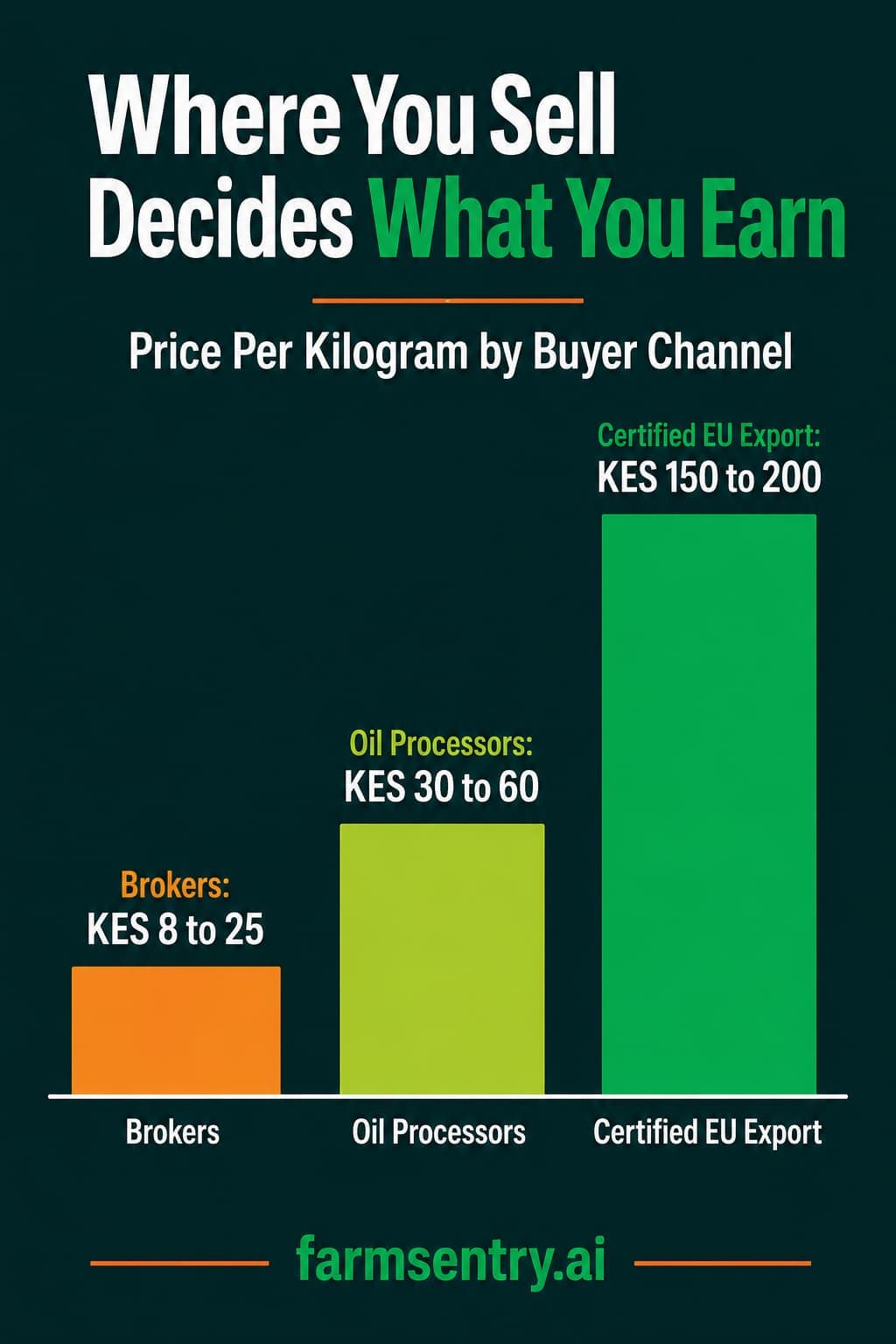
Prices swing hard by buyer channel:
Uncertified brokers: KES 8 to 25 per kg
Oil processors (reject grade): KES 30 to 60 per kg
Certified EU export: KES 150 to 200 per kg
🎯 Key Takeaway: Certification can lift your price by 300% to 400%. The gap between broker prices and export prices is enormous.
Knowing your true cost per tree changes how you make decisions. A financial management system that ties seedlings, inputs, and labor to each block shows your real margin.
How Do Contracts and Certification Work?
Contracts give you stable buyers. GLOBALG.A.P. certification unlocks premium export markets. Exporters offer training, inputs, and guaranteed prices. But many farmers break contracts to sell to brokers for instant cash.
One study found up to 82% of contracted farmers engage in side-selling (PRESM, 2019). Brokers take all grades and pay on the spot. But they pay far less, and you lose agronomic support and premium prices over time.
🔍 Definition: GLOBALG.A.P. is an international farm assurance standard. It covers pesticide limits, water quality, worker welfare, and traceability.
Individual certification costs KES 150,000 to KES 490,000. That’s too high for most smallholders. The solution is group certification through a cooperative.
✅ Best Practice: Join a producer group and use Option 2 certification. This shares one quality system across members. It cuts the cost per farmer to just KES 15,000 to KES 60,000.
Most farmers recover this cost in their first export harvest.
How Should I Manage Water and Cash Flow?
Use rain harvesting and drip irrigation for water, and use intercrops to bridge cash flow. Critics call avocado a water-guzzling crop. Global averages cite 800 to 1,280 liters per kilo. But that figure misleads in the rain-fed East African highlands.
Kakuzi PLC, a large Kenyan exporter, reported applying only about 88 liters of irrigation per kilo. They harvest rainwater in earth dams instead of drawing from rivers (Kakuzi, 2022).
💡 Pro Tip: Mature trees need 50 to 100 liters of water twice a week during dry spells. Use drip or micro-sprinklers to save water and cut fungal splash risk.
Because Hass takes three to four years to earn, intercrops bridge the gap:
Beans and peas: Quick harvest and they fix nitrogen in the soil.
Sweet potatoes: Act as living mulch to hold moisture.
Onions, garlic, cabbage: Short-cycle income crops.
What Are the Most Common Failure Cases?
The biggest failures come from waterlogging, manure burn, and side-selling. I’ve seen all three destroy farms that had real potential. And all three are preventable.
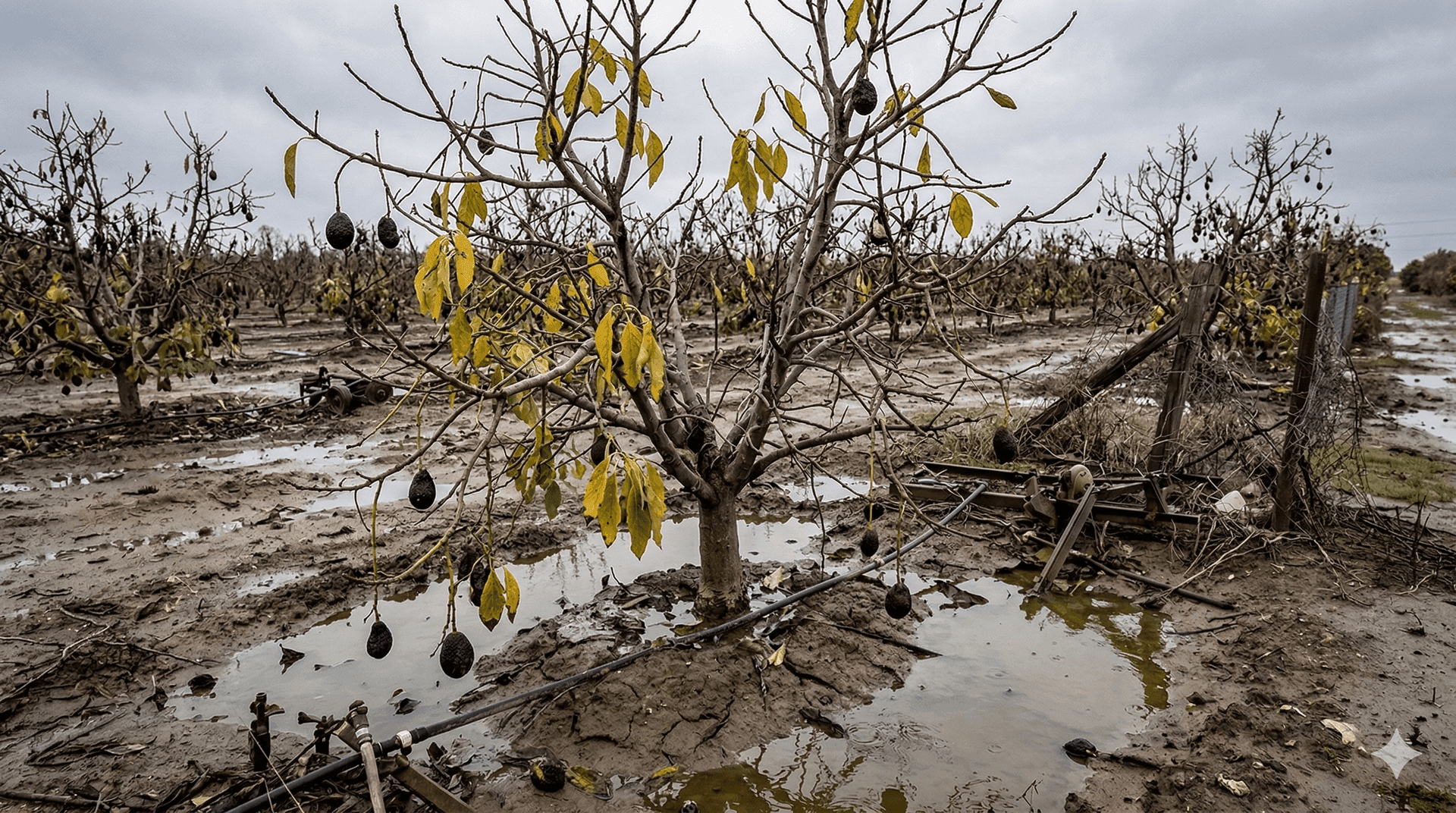
Waterlogging death: Planting in flat clay soil without drainage. Farmers lose 100% of trees during long rains.
Manure burn: Putting fresh manure and DAP on the root ball at planting. The heat and ammonia scorch and kill seedlings.
Side-selling collapse: Breaking export contracts for broker cash. You lose support and stay stuck in low-margin markets.
⚠️ Common Mistake: Using fresh, uncomposted manure. Always compost it fully before it touches young roots.
Conclusion and Action Plan
Hass avocado farming in East Africa rewards farmers who plan carefully and avoid the common traps. The market is hungry. But only quality fruit earns top prices.
Key Takeaways:
Plant at the right altitude on raised mounds to prevent root rot.
Hit 24% dry matter and Grade One caliber for export prices.
Use group certification to access premium EU markets affordably.
Your Next Steps:
Test your soil and water before you plant a single tree.
Choose Dusa rootstock and add pollinator varieties.
Join a cooperative to pursue Option 2 GLOBALG.A.P. certification.
Set up FCM traps and record-keeping from day one.
Start tracking your orchard data now. A clear farm dashboard helps you watch yields, costs, and tasks across every block in one place.
Share this stat: Certified avocado farmers earn up to 25 times more per kilo than those selling to brokers. Where you sell matters as much as what you grow.
MDPI. (2024). Farmers’ Knowledge, Perceptions, and Management Practices of False Codling Moth (Thaumatotibia leucotreta) in Smallholder Capsicum sp. Cropping Systems in Kenya. Available at: https://www.mdpi.com/2311-7524/10/4/331 [Accessed: 17 June 2026].