Your Avocado Trees Will Look Perfect Before They Die | FarmSentry Blog | FarmSentry
Written by Marcel Kore
March 8, 2026Mar 8, 2026
10 min read
Avocado
Your Avocado Trees Will Look Perfect Before They Die
In short
Avocado drainage problems in Kenya stay hidden for 2 years while roots are shallow. By year 3, root rot sets in silently. We lost 3 full acres, 3 years of work, and every single tree before we understood why. ---
The Farm That Looked Fine Until It Wasn’t
Picture this. You have been managing your avocado farm for two full years. Your avocado trees are green, tall, and strong. Your neighbors are impressed. You’re already thinking about the harvest.
Then one morning, a tree looks different. Then another. Then another. Within weeks, your entire farm is dying.
That’s exactly what happened to me at Morceau Farm in Mohoroni, Kenya.
We lost all of it. Three acres. Three years of watering, pruning, protecting, and waiting. Every single avocado tree died. We’re now cutting out stumps from ground that once held what looked like a promising farm.
This is the story I wish someone had told me before I planted a single seedling. It covers why avocado tree drainage problems in Kenya are so deadly, why they hide until it’s too late, and the one cheap test that could have saved everything.
If you’re in the planning stage or the early years of your avocado investment, read every word of this.
Why Did My Avocado Trees Look Healthy for Two Years Before Dying?
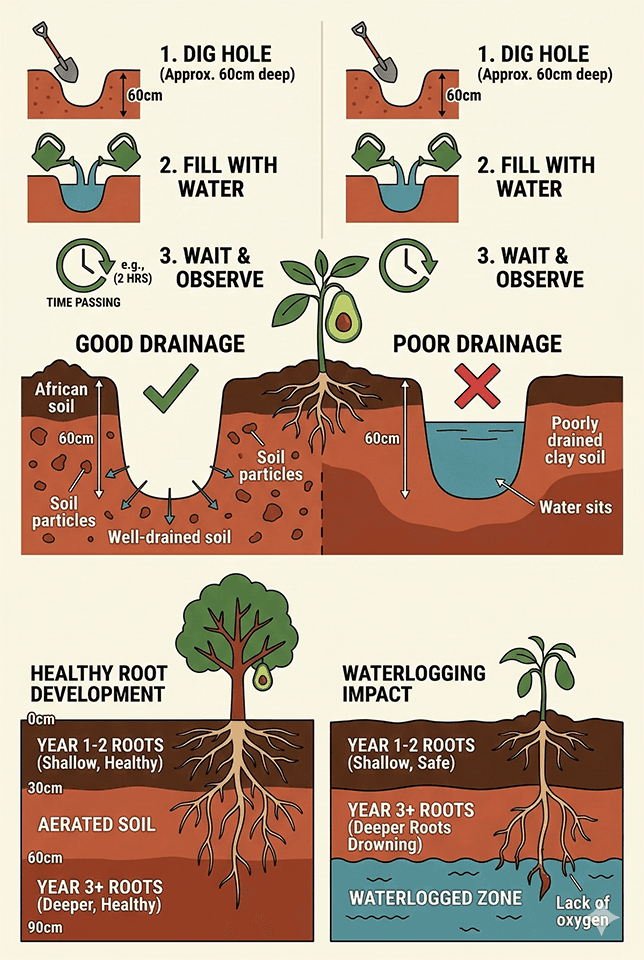
Here’s the thing. Avocado trees growing in poor drainage can look completely healthy for the first one to two years. Young roots stay shallow, sitting above the waterlogged zone. Once those roots push deeper in year two or three, they hit saturated ground, start to rot, and the tree collapses from below with almost no warning above ground.
This is the part that confuses most new farmers like me. Healthy growth isn’t proof of good conditions. It’s only proof that the roots haven’t gone deep enough to find the problem yet.
Here’s how it plays out:
Year 1: Roots are shallow. They stay in the top layer of soil, which drains reasonably well. The tree thrives.
Year 2: The tree is growing fast and still looks beautiful. You feel confident. But roots are creeping deeper.
Year 3: Roots hit the waterlogged zone below. Oxygen disappears at that depth. Root rot, often caused by a water mould called Phytophthora cinnamomi, takes hold. The tree starts dying from the bottom up.
🔍 Definition:Phytophthora cinnamomi is a water mould that destroys avocado roots in wet, poorly drained soils. It’s one of the leading causes of avocado tree death in East Africa.
By the time you see yellowing leaves or wilting branches, the root system is already destroyed. There’s nothing left to save.
What Happened at Morceau Farm: The Full Story
We planted our avocado trees on three acres in Mohoroni, Kenya. The land looked good. The soil looked good. Other farms nearby were growing avocados and doing well.
For two years, our trees were the picture of health. Strong trunks, full canopies, deep green leaves. Every time I walked the rows, I felt proud of the decision. We were already calculating what the harvest might bring in.
Then, in year three, one tree started to look off. A few yellow leaves. Nothing dramatic. I figured it was a nutrient issue and we added fertilizer.
The tree didn’t recover. Then the one next to it showed the same signs.
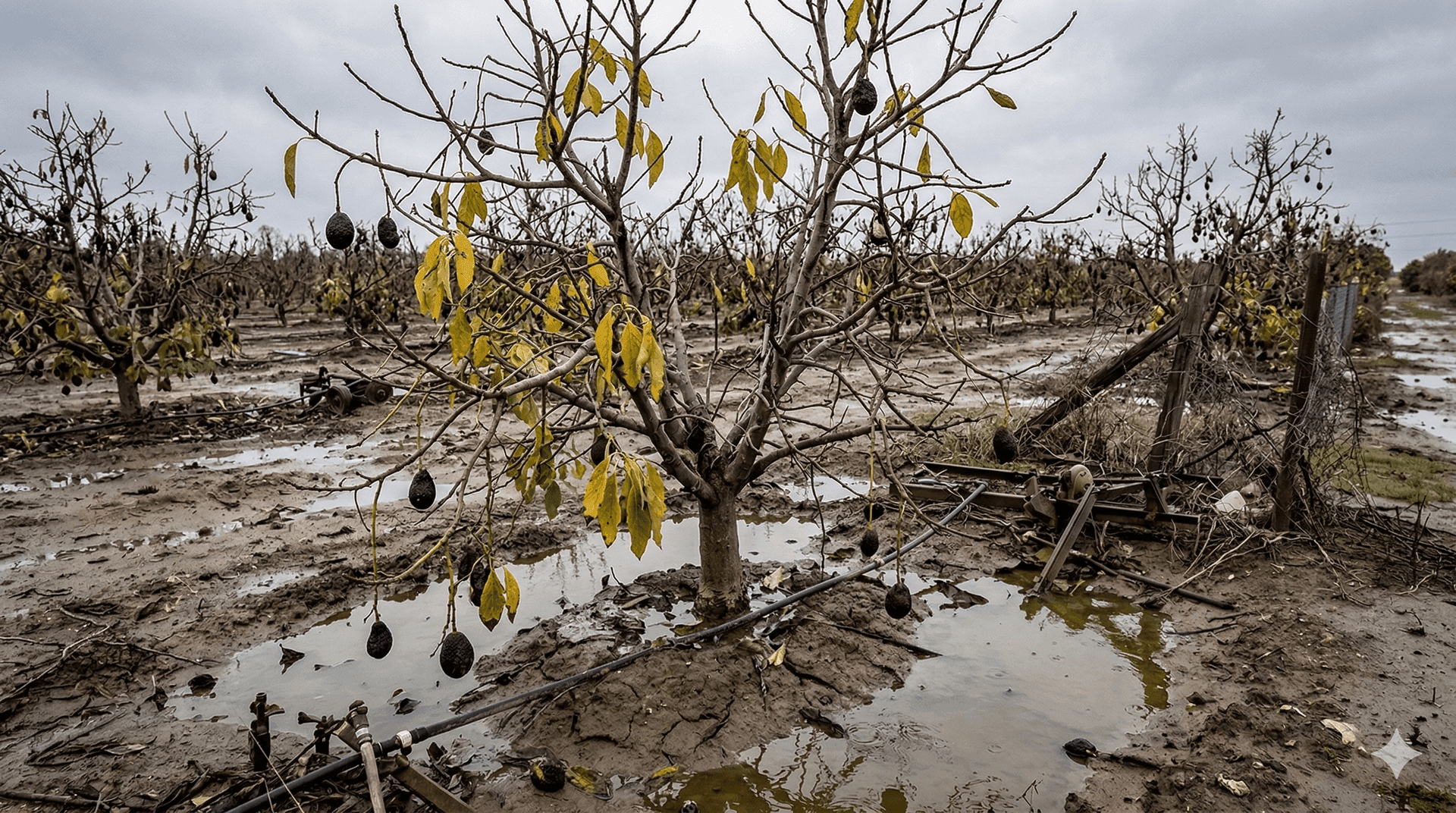
[IMAGE PLACEHOLDER 1: Insert photo of the dying avocado trees here, showing yellowing leaves and early signs of collapse across the rows at Morceau Farm]
Within weeks, trees across all three acres began to decline. We brought in agronomists. They tested the soil, walked the rows, and gave us their diagnosis: poor drainage causing severe root rot. The waterlogged subsoil had been sitting underneath us the entire time. Mind you all these efforts are costing money.
We tried everything they recommended:
Targeted fertilizer applications to support root health
Fungicide treatments to fight the root rot pathogen
Improved surface drainage channels around the perimeter
Foliar sprays to keep the canopy alive while we treated the roots
Nothing worked. When root rot reaches that scale, there’s no coming back. The damage is done underground long before you can see it above ground. One by one, then in groups, the trees died.
⚠️ Common Mistake: Many farmers treat avocado decline as a nutrient deficiency first. Yellowing leaves and wilting can look like a feeding problem. But if poor drainage is the cause, no amount of fertilizer will fix it. You’re feeding a tree whose roots can no longer absorb anything.
We had to make the hardest decision. We stopped spending money trying to save the unsaveable. We accepted the loss.
We’re now removing the stumps. Three acres of dead avocado stumps. Three years of work.
📊 By the Numbers: We invested three years of time and labor across three full acres. Every tree is gone. The cost wasn’t just money. It was time you simply can’t get back.
How Did We Miss the Signs? The Neighbor Who Fooled Us
Before we planted, we did what most sensible farmers do. We looked around at what was working.
Our neighbor (a prominent politician) had avocado trees that were about two years old at the time. Tall, full canopy, clearly thriving. He encouraged us to plant. We saw his success, figured the conditions were similar to ours, and went ahead.
What we didn’t know was this: his trees were also two years old. His roots had also not gone deep enough yet. His drainage was just as poor as ours.
His trees started dying the same year ours did. Same pattern. Year three. One by one.
By the time we went back to check on his farm for some reassurance, those same trees that had convinced us to plant were dead. The proof we had relied on was just a farm that hadn’t failed yet. He had already moved on and was planting Napier grass on the same land for his new venture with cows.
💡 Pro Tip: Don’t use a neighbor’s young avocado trees as proof that your land is suitable. Trees that are two years old or younger haven’t tested their drainage yet. Ask to see trees that are at least 4 years old and still healthy. That’s the real test.
What Should You Do Before You Plant a Single Avocado Tree?
The most important thing you can do before planting avocados is test your soil drainage. This test is free, takes about an hour, and could save you years of heartbreak.
Here’s exactly how to do it:
The Percolation Test (Drainage Test):
Dig a hole in your intended planting area. Make it about 60 centimetres deep and 30 centimetres wide.
Fill the hole completely with water.
Let it drain fully. This first fill saturates the soil.
Fill the hole with water again immediately after.
Set a timer and watch.
Measure how many centimetres of water drain away every hour.
✅ Best Practice: Test multiple spots across your land. Drainage can vary from one section to another. One good result in a single spot doesn’t mean the whole farm drains well.
If your land has poor drainage, you have options before planting. You can create raised planting mounds at least 60 cm high, install French drains, or choose a different section of land entirely. These are manageable fixes. Replanting after total crop failure is not.
What Are Signs of Root Rot in Avocado Trees?
Root rot in avocado trees caused by poor drainage shows several visible signs, though they often appear late. Key signals include yellowing or pale leaves, wilting despite adequate watering, sudden leaf drop, dark lesions at the base of the trunk, and a sudden stop in new growth.
Watch for these signs, especially in year two or three:
Leaves turning pale green or yellow, starting with older leaves
The tree looks thirsty even after watering, because the roots can no longer absorb water
Brown, mushy roots if you carefully expose the root zone
A foul smell near the base of the trunk in wet conditions
Dying branches starting from the tips and moving inward
🎯 Key Takeaway: By the time above-ground symptoms appear, root rot is usually advanced. Your best protection is prevention through soil testing before you plant. Treatment rarely works at scale.
Can You Save an Avocado Tree That Has Root Rot from Poor Drainage?
Let’s be honest. Saving an avocado tree with advanced root rot from waterlogged soil is extremely difficult once the root system is compromised. Early-stage cases may respond to better drainage and fungicide treatment. But trees with more than 30 to 40 percent root damage rarely recover.
We tried the following at Morceau Farm after diagnosis:
Fungicide drenches around the root zone
Surface drainage improvements
Fertilizer applications to support weakened trees
Removal of heavily affected soil and backfilling
None of it worked. The rot was too widespread, across too many trees, over too large an area. The agronomists were honest with us. They said we were fighting a battle that had already been decided underground.
Saving individual trees caught very early is possible with the right treatment. Saving an entire three-acre farm once root rot has taken hold is not realistic.
How Can You Track Costs and Decisions on Your Avocado Farm?
One regret I carry from this experience is that I wasn’t tracking my costs carefully. I know roughly what we lost, but I can’t give you an exact number. I wasn’t recording expenses consistently from the start.
That matters more than you’d think. When things go wrong, knowing your real numbers helps you make clear decisions. Should you keep treating? Should you cut your losses? You can’t answer those questions honestly without data.
Tracking every farm input, from seedlings to fertilizer to labor, gives you a clear picture of what an investment is actually costing you. Tools like FarmSentry's finance module let you log expenses as you go and pull up a clear cost breakdown at any point. You always know what you’ve spent and what you’re risking.
Had I been tracking costs from year one, I might have made the call to stop treating earlier. I would have seen the numbers and understood what continuing to spend was actually buying me. Nothing, as it turned out.
How Should You Log Farm Activities to Catch Problems Early?
Keeping records of what you do on your farm every day sounds like extra work. It’s not. It’s how you spot patterns before they become disasters.
If I had been logging weekly observations about each tree, I might have noticed that trees in certain sections were declining slightly before others. That pattern would have pointed me toward a drainage problem in those areas much sooner.
Recording daily farm activities, treatment applications, and tree health notes in one place gives you a searchable history. FarmSentry’s activity logging feature lets you log treatments, observations, and farm events so you can look back and see exactly when a problem started and how it progressed.
Patterns save farms. But you can only see patterns if you’re keeping records.