Farm Management Best Practices Every Farmer Needs to Know | FarmSentry Blog | FarmSentry
Written by Claud Fields
May 26, 2026May 26, 2026
10 min read
Record Keeping
Farm Management Best Practices Every Farmer Needs to Know
In short
Good farm management means tracking your animals, finances, and daily tasks without gaps. Farms with clear systems consistently outperform those flying blind, earning more while spending less. Here's how to build one. ---
Introduction
What separates a thriving farm from one that barely breaks even?
It’s rarely the weather, the land, or even luck. In most cases, the difference comes down to how well the farm is managed day to day. According to the USDA, farms that use structured record-keeping and planning tools report consistently better financial outcomes than those relying on memory alone (USDA/FAS, 2025).
And yet plenty of farmers still run their operations with a mix of paper notebooks, mental checklists, and a lot of guesswork. Tasks slip through the cracks. Costs creep up without anyone noticing. Decisions that could be based on solid data get made on gut feeling instead.
This guide will help you fix that. You’ll learn how to build a solid farm management system, organize your daily operations, track your animals and finances, and use technology to work smarter. Whether you run cattle, crops, poultry, or a mixed operation, these strategies apply to you.
What Is Farm Management?
Farm management is the process of planning, organizing, and controlling everything that happens on a farm to get profitable, sustainable results. It covers livestock care, crop production, financial oversight, labor coordination, and resource use. Good farm management connects every part of your operation so nothing gets overlooked and every decision has a purpose.
Think of it as the operating system for your farm. When it runs well, everything else runs well too.
🔍 Definition: Farm management refers to the organized use of land, labor, capital, and information to achieve farm goals. It includes both day-to-day decisions and long-term planning across all areas of the operation.
Why Does Good Farm Management Matter?
Good farm management directly affects your bottom line, the health of your animals, and the long-term viability of your land. Farms with clear systems waste less feed, lose fewer animals to preventable illness, and make smarter purchasing decisions. Over time, those advantages add up to real money.
A disorganized farm isn’t just stressful. It’s expensive.
📊 By the Numbers: Industry research consistently shows that farmers who track expenses and production data make better input decisions, reduce waste by 10 to 20 percent, and improve profitability over a 3-year period compared to untracked operations (FAO, 2003).
The benefits of structured farm management include:
Lower operating costs through reduced waste
Healthier livestock with fewer emergency vet calls
Better timing on buying, selling, and restocking decisions
Improved compliance with regulatory and certification requirements
Greater confidence when applying for farm loans or grants
How Do You Build a Daily Farm Routine?
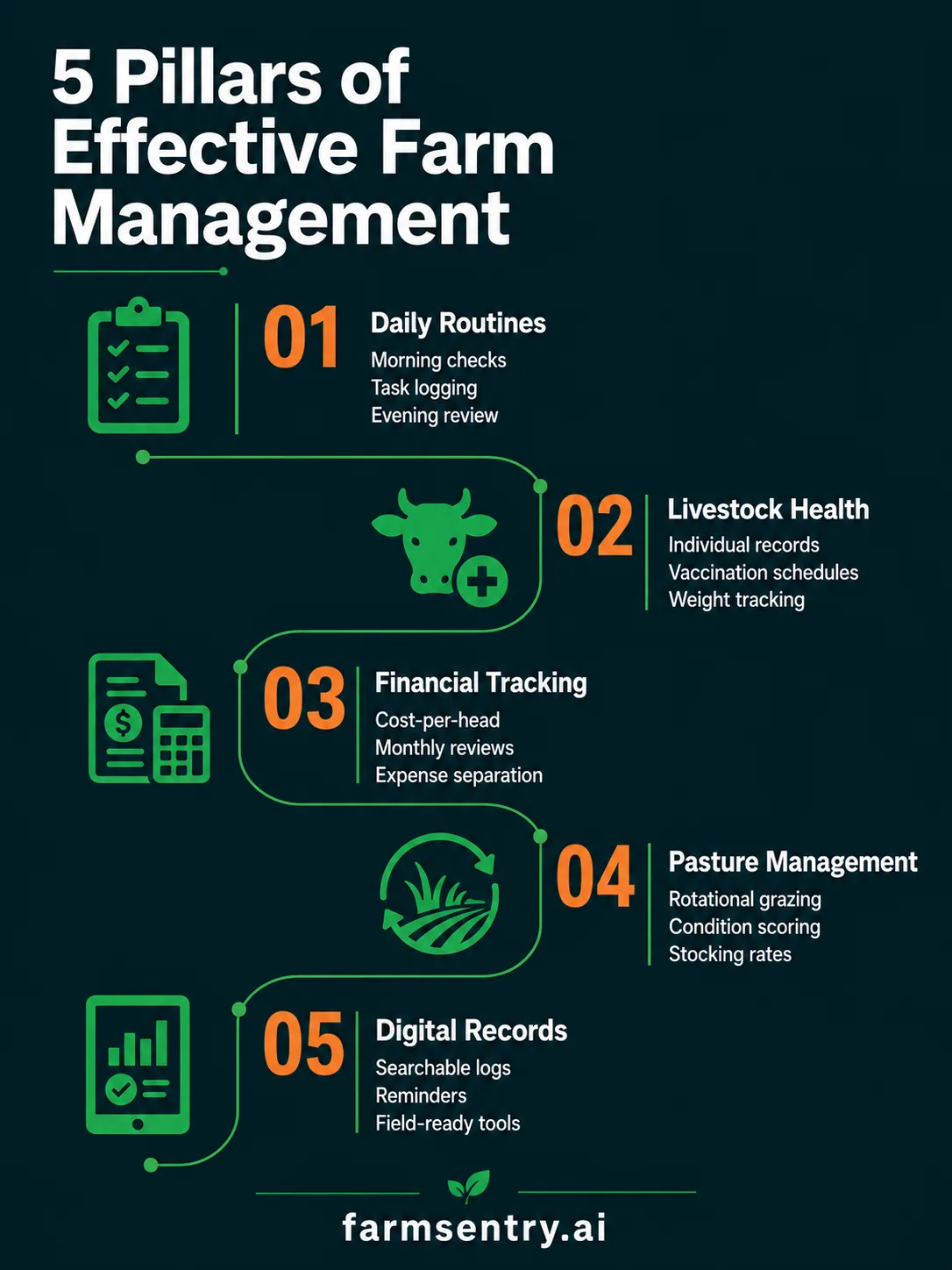
A daily farm routine is a set schedule of tasks performed at consistent times to keep animals healthy, operations efficient, and problems spotted early. A strong routine includes morning health checks, feeding and watering, task logging, and end-of-day reviews. Consistency is the key ingredient.
Most farm problems are caught early by farmers who look carefully and regularly. The ones that spiral into costly emergencies are usually the ones nobody noticed until it was too late.
✅ Best Practice: Walk your entire operation every morning before anything else. A quick visual check of animal behavior, water sources, fencing, and feed levels takes 20 minutes but can save hundreds in reactive costs.
Here’s a simple daily structure to build from:
Morning check: Animal health, water levels, fencing integrity
Feeding and care: Follow scheduled feeding plans for each species
Task execution: Complete planned maintenance, treatments, or movements
Afternoon check: Re-observe animals, restock feeders if needed
Evening log: Record what happened, note anything unusual
FarmSentry’s activity logging tools make this easy by letting you record daily tasks, feeding schedules, and treatment notes from your phone or tablet in the field. Nothing gets forgotten because everything gets captured in real time.
Managing Your Livestock the Right Way
Livestock care is the heart of most farm operations. Healthy animals grow faster, reproduce more reliably, and need fewer emergency interventions. The key is staying ahead of problems instead of reacting to them.
That means tracking individual animal health, not just the herd as a whole.
💡 Pro Tip: Tag and record each animal individually from birth or purchase. Tracking weight gain, vaccination dates, and treatment history by individual animal helps you spot underperformers early and make better culling, breeding, and selling decisions.
Essential livestock management practices include:
Health monitoring: Check animals daily for signs of illness, injury, or stress
Vaccination schedules: Stay current on all required and recommended vaccinations
Weight tracking: Weigh regularly to assess growth rates and feed conversion
Breeding records: Track breeding dates, gestation progress, and births
Mortality logging: Record any deaths with cause, to identify patterns
Research confirms that genetic non-compliance rates in livestock and crop seed supply, where inputs are not what they’re claimed to be, can exceed 36 percent in unverified supply chains. That’s a risk that structured farm records help producers identify and avoid (World Coffee Research, 2023).
FarmSentry’s livestock management features support herd and flock tracking across 100+ species, from cattle and pigs to poultry and goats. You can monitor health records, breeding cycles, and weight history in one place so your entire herd picture is always current.
⚠️ Common Mistake: Many farmers track herd-level averages but miss individual animal problems. An animal that’s 20 percent below average weight may not stand out in group data, but it represents a real financial and welfare concern.
How Can Financial Tracking Improve Your Farm?
Financial tracking shows you exactly where money comes in, where it leaks out, and which parts of your operation are genuinely profitable. Without it, you’re running a business without a scoreboard. You might feel busy, but you can’t measure whether that busyness is actually making you money.
I’ve seen this play out more times than I can count. Farmers who start tracking properly often discover that some of their most labor-intensive activities are also their least profitable.
🎯 Key Takeaway: Knowing your cost-per-head or cost-per-acre is the difference between guessing and managing. It tells you whether to expand, cut back, or adjust your practices before the losses become serious.
Key financial habits every farmer should build:
Record all income and expenses as they happen, not at tax time
Separate costs by enterprise (cattle, crops, poultry) to see true profitability
Calculate cost-per-head or cost-per-unit for your primary outputs
Compare actual costs to your budget monthly, not annually
Review profit trends across seasons to identify patterns
A farm financial management system that ties feed costs, vet bills, and labor to individual animals or paddocks gives you the real number. You stop estimating and start managing with accuracy.
What Role Does Technology Play in Modern Farm Management?
Technology has become central to farm management by replacing manual, error-prone processes with fast, reliable digital systems. Farm management software, mobile apps, and sensor tools let farmers capture data in the field, spot problems early, and make decisions based on evidence rather than memory.
Here’s the thing: the barrier to adopting farm technology has dropped a lot in recent years. Most tools are now affordable, mobile-friendly, and built for farmers, not IT professionals.
📊 By the Numbers: A growing body of research suggests that farms using digital management tools reduce administrative time by up to 30 percent while improving record accuracy. That accuracy matters most during audits, loan applications, or herd health reviews. Structured digital record-keeping is recognized by agricultural institutions as a prerequisite for sound agronomic decision-making (MAAIF Uganda, 2020).
Key technology areas to adopt:
Digital record keeping: Replace paper logs with searchable, cloud-backed records
Weather integration: Monitor conditions that affect planting, spraying, and grazing decisions
Inventory tracking: Avoid running out of feed, medication, or key supplies
Reporting tools: Generate financial and compliance reports automatically
💡 Pro Tip: Start with one digital tool that solves your biggest pain point. Many farmers begin with livestock health records or daily task logging, then expand once they see the time savings.
Common Farm Management Mistakes to Avoid
Even experienced farmers fall into habits that quietly cost them money and time. Recognizing these patterns is the first step to fixing them.
The most costly farm management mistakes include:
Skipping daily health checks: Problems caught on day one cost far less than problems caught on day seven
Mixing expenses across enterprises: Without clean financial separation, you can’t see which part of your farm is losing money
Relying on memory for health records: Vaccination gaps and missed treatments happen when records live in your head
Over-stocking pastures: Too many animals on too little ground degrades pasture at a rate that takes years to recover from
No succession or emergency plan: If you can’t work for a week, who knows what needs doing and when?
⚠️ Common Mistake: Many farmers review finances once a year at tax time. By then, it’s too late to adjust. Monthly reviews catch problems while you still have time to respond.
Conclusion and Action Plan
Farm management isn’t just about keeping things organized. It’s about building a system that gives you reliable information, cuts preventable losses, and helps you make better decisions every single day.
Let’s be honest: most of the problems that cost farmers real money aren’t bad luck. They’re the result of not knowing what was happening until it was too late.
Key Takeaways:
Good farm management starts with consistent daily habits, especially health checks and task logging
Financial tracking by enterprise reveals which parts of your farm are genuinely profitable
Digital tools reduce errors, save time, and give you the data you need to grow with confidence
Next Steps: Start This Week
Spend 20 minutes writing down every task you perform daily. That becomes your baseline routine.
Open a simple spreadsheet or start a trial of a farm management platform to log this week’s activities and expenses.
Pick one area, livestock health, pasture condition, or finances, and commit to tracking it consistently for 30 days.
Shareable Quote: “What gets measured gets managed. The farms that thrive are the ones that stop guessing and start tracking.”