The Farm Labor Management Optimization Guide for Specialty Crop and Livestock Operators | FarmSentry Blog | FarmSentry
Written by Claud Fields
April 17, 2026Apr 17, 2026
12 min read
Record Keeping
The Farm Labor Management Optimization Guide for Specialty Crop and Livestock Operators
In short
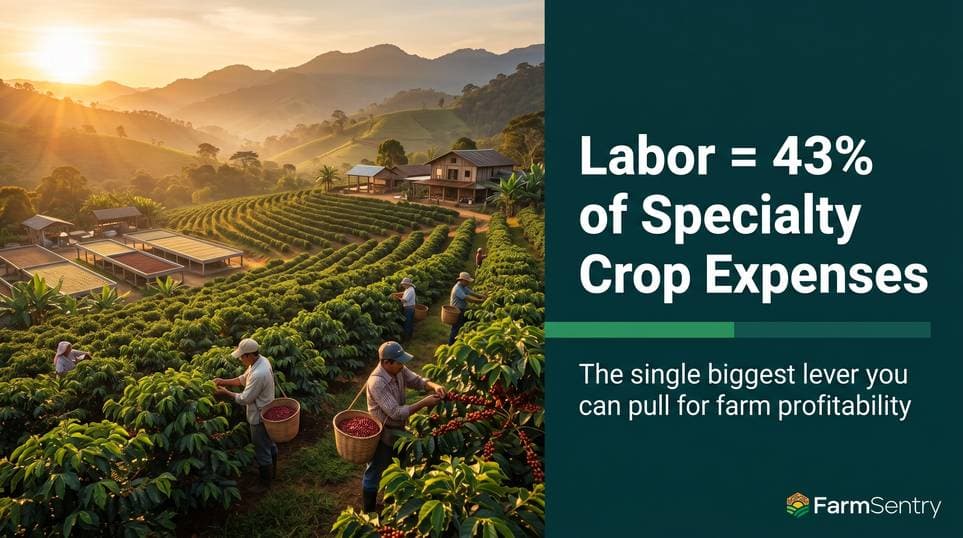
Labor eats up 43% of specialty crop expenses. This farm labor management optimization guide walks you through how to plan, track, and control your workforce so you protect your margins and stay on the right side of the law.
Here's a number that should stop you cold. For greenhouse and nursery operations, labor eats up 42 to 43 percent of total production expenses (USDA, 2022). For fruit and tree nut farms, that figure sits between 39 and 40 percent (USDA, 2022). Labor isn't just a line item on your budget. It's the single biggest lever you can pull to improve your farm's profitability. The problem is that most mid-to-large scale specialty crop and livestock operations still manage their workforce reactively. You hire in a panic before peak season. You track hours on paper or in scattered spreadsheets. You find out about a compliance violation only after a penalty arrives. That approach is costly, and it's getting more dangerous every season. This farm labor management optimization guide gives you a practical, step-by-step framework. You'll learn how to forecast your labor needs accurately, track time without payroll errors, understand your true labor costs, and stay compliant with wage and housing laws.
Here's what we'll cover:
How to assess and forecast your seasonal labor needs
How to track time and task completion accurately
How to calculate and benchmark your true labor costs
Proven strategies to improve labor efficiency
Key compliance rules you can't afford to miss
How to retain your best workers season after season
Why Is Farm Labor So Expensive?
Farm labor is expensive because agricultural production is biologically time-sensitive. Crops ripen on a narrow schedule, and livestock need daily care regardless of weather or market conditions. That forces operations to surge headcount during short peak windows, then manage a lean crew in the off-season. The cost gap between farm types is dramatic. Row crop farms running advanced mechanization spend just three to four percent of total cash expenses on labor (USDA, 2022). Specialty crop farms can spend ten times that amount. The difference comes down to how much human touch each crop requires. 📊 By the Numbers: US farm operators will face a deficit of 10 million workers over the next decade due to mass retirement and slowing population growth . Real wages for non-supervisory crop and livestock workers grew at 1.8 percent annually in recent years, up from 1.1 percent annually between 1990 and 2022 (USDA via The Packer).
The good news is that labor expenditures as a share of gross cash farm income have held relatively steady, averaging 10.4 percent from 2021 to 2023 (USDA via The Packer). Farms that optimize well are absorbing higher wages through better productivity. The farms that don't optimize are quietly losing margin every season.
How Do You Calculate Your Seasonal Labor Needs?
Calculating your seasonal labor needs means breaking your farm into separate enterprises, estimating labor hours per unit of output for each one, and then mapping those requirements against your production calendar month by month. Start with benchmarked labor hour estimates by enterprise type. Research from the University of Minnesota's Center for Farm Financial Management gives you solid baseline figures to work from :
Corn and soybeans, under 500 acres: 6.0 hours per acre
Corn and soybeans, over 2,000 acres: 1.7 hours per acre
Dairy cows (breeding herd): 39.0 hours per head
Beef cow-calf operations: 8.4 hours per head
Swine, farrow to finish: 8.4 hours per litter
Once you have enterprise estimates, build a seasonal labor calendar. A seasonal calendar is a month-by-month matrix that plots your agronomic events, such as planting, pruning, harvest, and post-harvest processing, against your labor requirements for each crew type .
✅ Best Practice: Separate your permanent staff requirements from your seasonal crew needs on the calendar. Permanent employees carry fixed overhead. Seasonal workers are a variable cost tied directly to revenue-generating tasks. Your fixed costs must never exceed your operation's off-season carrying capacity .
🎯 Key Takeaway: Farms larger than 2,000 acres achieve labor efficiencies that are dramatically lower per acre than smaller operations . Scale creates a competitive advantage, but only if you actively manage toward it.
How Should You Track Farm Labor Hours?
Accurate farm labor hour tracking requires a digital system that records clock-in and clock-out events by worker, assigns those hours to specific tasks or field blocks, and feeds data directly into payroll without manual re-entry. Let's be honest. Paper timesheets fail in agricultural environments. Workers are spread across large geographic areas, often without reliable supervision. Errors compound into payroll mistakes, and payroll mistakes create compliance exposure. Modern mobile time-tracking apps solve this by using GPS geofencing to verify worker location at clock-in . Geofencing means the system draws a virtual boundary around your field or facility. If a worker tries to record time outside that boundary, the system blocks the entry. That eliminates time theft and makes sure labor costs land against the right enterprise.
A key issue on many specialty crop farms is the reliance on consumer messaging apps, like WhatsApp, for task coordination. These tools are familiar and work in low-bandwidth conditions. But they create what researchers call the "infinite scroll" problem. Critical task assignments get buried in unstructured group chats, leading to duplicated work and operational slowdowns . Structured task management platforms are replacing these informal systems. They assign priorities, group workers into role-specific channels, and capture photo or voice updates in real time . Many now integrate directly with the tools workers already use, converting field notes into timestamped, geolocated records automatically. Tracking daily labor activity doesn't have to be a separate administrative burden. [FarmSentry's activity logging tools](/features/activities) let you record labor hours, task completions, and field-specific notes in one place, so nothing falls through the cracks during your busiest weeks.
What Does Farm Labor Actually Cost You?
Your true farm labor cost is not just the hourly wage. It includes payroll taxes, workers' compensation insurance, unemployment contributions, and the value of any housing or meals you provide.
🔍 Definition: A "fully loaded" labor cost is the total amount you spend per worker, including all direct wages, government-mandated contributions, and in-kind benefits like housing. Failing to account for all of these distorts your profitability calculations.
For commercial crop operations, the target benchmark for labor efficiency is to keep total labor costs below 11 percent of gross revenue (Purdue University, 2026). The labor productivity benchmark is to generate more than $750,000 in gross farm income per full-time equivalent worker (Purdue University, 2026). For farms over 2,000 acres, the average labor efficiency achieved between 2007 and 2024 was 8.9 percent of gross revenue. That's well under the 11 percent benchmark and a sign of strong operational discipline (Purdue University, 2026). Understanding your cost-per-enterprise matters just as much. You need to know whether your harvest crew is profitable relative to your pack house team, and whether your livestock labor is in line with industry norms. [FarmSentry's financial management module](/features/financials) connects labor hours to specific cost-per-head and cost-per-acre calculations, so you're working with real numbers, not estimates.
⚠️ Common Mistake: Many farm operators don't put a dollar value on their own labor or that of unpaid family members. The FAO's guidelines on cost of production statistics are clear: failing to value owner-operator labor at fair market rates artificially inflates net returns and prevents accurate financial benchmarking .
How Can You Improve Labor Efficiency on Your Farm?
Improving labor efficiency takes three parallel strategies: smart mechanization decisions, standardized work methods, and better scheduling.
Mechanization: Substituting capital for labor only makes sense when the return justifies the depreciation and financing cost. Use the Benefit-Cost Ratio (BCR) to evaluate competing investments. If a $200,000 piece of equipment yields $340,000 in benefits and a $600,000 investment yields $900,000, the smaller investment delivers a superior return per dollar despite the larger one offering a higher absolute net benefit .
Be aware that mechanization has labor market effects beyond your own operation. A field study in India showed that reducing barriers to mechanization tripled technology adoption and raised farmer profits by six percent, but also reduced local piece-rate wages by six percent as labor demand fell . Understand the ripple effects before you commit.
Standard Operating Procedures (SOPs): An SOP is a documented, step-by-step guide for a specific farm task. SOPs cut confusion during onboarding, reduce supervisor time spent re-training seasonal workers, and make sure product quality stays consistent regardless of which workers perform the task . They're also essential for passing food safety audits under regulations like the FSMA Produce Rule .
Scheduling and Cross-Training: Excessively long shifts reduce both productivity and accuracy. Structured rest periods produce higher aggregate output over a full day than continuous fatigued labor . Cross-training workers across multiple roles and enterprise areas builds a flexible workforce that can absorb unexpected bottlenecks, like equipment breakdowns or weather delays, without requiring emergency overtime .
💡 Pro Tip: Use a skills matrix to map required competencies against your current workforce. This identifies specific training gaps before the season starts, not during it. A skills matrix tracks Knowledge, Skills, and Behaviours (KSB) across a progression from initial instruction to full mastery .
What Are the Key Compliance Rules for Agricultural Workers?
Agricultural labor compliance covers wage rates, overtime thresholds, piece-rate calculations, and housing standards. The rules vary by location and operation type, and they're getting stricter.
Wage and Overtime Rules: In the United States, the Fair Labor Standards Act (FLSA) sets minimum wage requirements for agricultural workers, with specific exemptions for overtime that vary by state (FLSA, cited in Source 1). Colorado, for example, mandates time-and-a-half overtime for agricultural workers after 48 hours per week, dropping to a 56-hour threshold during up to 22 designated peak weeks for qualifying seasonal employers (CDLE, 2024).
Piece-Rate Compliance: Piece-rate workers, who are paid per unit harvested rather than per hour, must still earn an effective hourly rate that meets or exceeds the minimum wage . In California, AB 1513 also requires separate compensation for all rest and recovery breaks at the higher of the applicable minimum wage or the worker's average hourly piece-rate earnings for the week .
H-2A Housing: If you use the H-2A guest worker visa program, you must provide housing at no cost to workers who can't return to their permanent residences daily. That housing must meet federal OSHA and state health code standards covering safety, sanitation, and occupancy density (USDOL, cited in Source 1).
EU Social Conditionality: Starting in 2025, farmers receiving direct payments under the EU's Common Agricultural Policy face financial penalties for violating labor rights directives, including safe work equipment standards and transparent working conditions (DignityFIRM, 2025). This represents a global shift toward linking agricultural subsidies directly to worker welfare compliance.
Documenting your compliance is as important as achieving it. [FarmSentry's reports and export tools](/features/reports) let you generate audit-ready compliance documentation, including labor records, treatment logs, and wage histories, without spending hours assembling data from multiple sources.
How Do You Retain Your Best Seasonal Workers?
Worker retention reduces the recurring cost of recruiting and onboarding replacement staff. And it preserves the institutional knowledge that makes your operation run smoothly year after year. Retention starts with recruitment. Treat hiring as a continuous process, not a seasonal emergency. Build pipelines through local agricultural colleges, FFA and 4-H networks, and specialized job boards. Write clear job descriptions that accurately reflect physical demands and benefits. Once workers are hired, structured onboarding matters. Workers who understand their role, their daily schedule, and the farm's expectations from day one are far more likely to come back the following season. Regular performance feedback, both positive and corrective, keeps workers engaged in the farm's success .
Physical environment drives retention too. When tools are organized, clearly labeled, and in good working order, workers don't waste time searching for equipment . When hazards get identified and corrected quickly, workers feel respected. That sense of respect is a powerful retention tool in a tight labor market. Fair and transparent compensation is the foundation. When piece-rate systems are tied directly to individual productivity data, high-performing workers get rewarded appropriately. That transparency drives morale and cuts turnover .
Conclusion and Action Plan
Managing farm labor well is no longer optional. Rising wages, tightening compliance rules, and a shrinking labor pool mean that reactive, paper-based workforce management will cost you more every single season.
Key Takeaways:
Labor costs up to 43 percent of specialty crop expenses. Knowing your fully loaded cost per enterprise is where meaningful improvement starts (USDA, 2022).
Digital time tracking and structured task management cut the hidden costs of paper errors, time theft, and unstructured communication .
Compliance with piece-rate, overtime, and housing rules requires current, accurate records. Documentation isn't optional. It's your legal protection.
Implementation Roadmap:
1. This week: Build a seasonal labor calendar for your operation. Map each enterprise, estimate labor hours by month, and identify your three peak demand weeks.
2. This month: Audit your current time-tracking method. Identify any gaps between hours recorded and hours paid. If you're using paper or spreadsheets, evaluate a mobile time-tracking solution with GPS verification.
3. Before next season: Write SOPs for your five highest-volume tasks. Create a skills matrix for your core crew. Cross-train at least two workers in roles outside their primary function.
4. Ongoing: Calculate your labor efficiency ratio each quarter. Compare it against the 11 percent gross revenue benchmark. Use your [farm activity logs](/features/activities) and [financial reports](/features/reports) to track trends over time.
You can track labor hours, assign tasks to specific field blocks, and pull compliance-ready records from [FarmSentry's dashboard](/features/dashboard) in real time, keeping your entire workforce picture visible in one place.
Social Sharing Hook: "Specialty crop farms spend up to 43 cents of every production dollar on labor. The farms that thrive are the ones that manage every one of those cents on purpose."