Growing Ruiru 11 Coffee at Low Altitude: A Practical Guide for 1,200m–1,400m Farmers | FarmSentry Blog | FarmSentry
Written by Claud Fields
May 7, 2026May 7, 2026
14 min read
Coffee
Growing Ruiru 11 Coffee at Low Altitude: A Practical Guide for 1,200m–1,400m Farmers
In short
Growing Ruiru 11 coffee low altitude (1,200m–1,400m) is hard work. You need irrigation, grafting onto SL28 rootstock, and serious nutrition management. Get those three things right and you're looking at 10–15 kg of cherry per tree every year. ---
Introduction
I’ve watched Ruiru 11 fields fall apart within weeks of a heavy crop. Leaves dropping, branches dying back, the whole tree looking like it’s given up. It’s one of the most demoralizing things to see after months of work.
And it happens constantly at elevations between 1,200 and 1,400 meters. The heat is higher up there. The soil drains faster. The plant is fighting harder just to stay alive.
Here’s the thing: most extension advice was written for farmers above 1,600 meters. If you’re working lower, you’re dealing with a completely different set of problems. Your trees ripen faster, your roots dry out quicker, and pests breed more rapidly in the warmer air.
This guide gives you practical, science-backed answers to those specific problems. You’ll learn how to establish Ruiru 11 correctly, feed it at the right rates, protect it from diseases extension officers rarely warn you about, and improve your cup quality through smart processing. Whether you farm in Kenya’s Kisumu County basin, Ethiopia’s lower rift zones, Tanzania’s mid-altitude plains, or any warm lowland in between, this applies directly to your conditions.
What Is Ruiru 11 and Why Does It Matter at Low Altitude?
Ruiru 11 is a compact, F1 hybrid Arabica coffee variety developed for disease resistance, high yields, and suitability across a wide range of elevations. Released in 1985 by Kenya’s Coffee Research Foundation, it is the benchmark disease-resistant cultivar for warm, humid agroecological zones where traditional tall varieties like SL28 cannot survive.
The variety was bred specifically to resist Coffee Berry Disease (CBD), which destroyed roughly 50% of Kenya’s entire coffee production in a single outbreak in 1968 (World Coffee Research, 2024). Its resistance relies on multiple stacked genes, making it remarkably durable. At the time of this writing, there’s no documented widespread breakdown of CBD resistance in genetically pure F1 Ruiru 11 fields.
At 1,200m to 1,400m, that disease resistance is your biggest asset. SL28 and SL34, the traditional tall varieties, are effectively unmanageable at this elevation without a massive chemical budget. The warmer, wetter environment guarantees CBD and Coffee Leaf Rust outbreaks in unprotected trees. Ruiru 11 removes that threat entirely, provided you buy genuine certified F1 seed.
🎯 Key Takeaway: Ruiru 11’s disease resistance only works if you plant true F1 seeds. Never plant cherries harvested from a neighbor’s Ruiru 11 tree. The second generation loses resistance and reverts to a tall, low-yielding plant.
Why Is Growing Ruiru 11 at Low Altitude So Challenging?
Growing Ruiru 11 at 1,200m–1,400m is challenging because higher temperatures accelerate cherry ripening, reduce bean density, increase drought stress, and speed up pest reproduction cycles. These four factors combine to shrink both your yield potential and your cup quality compared to higher altitudes.
Here’s what happens at the physiological level. Ruiru 11 already has a notoriously shallow root system, quite unlike the deep taproot of SL28 (Global Coffee Platform, 2021). At lower elevations, higher evapotranspiration rates mean the soil dries out far faster than those shallow roots can compensate. The result is chronic water stress, floral abortion, and cherry drop.
Temperature also alters flavor directly. Above 1,600 meters, cool nights slow sugar metabolism, allowing complex acids and aromatics to build up in the bean. At 1,200 meters, the process accelerates. You get softer beans, flatter acidity, and a cup that struggles to reach specialty-grade scores without extra processing steps.
📊 By the Numbers: Optimal temperature for Ruiru 11 is 15°C–27°C. At 1,200m in warmer zones, temperatures regularly push toward 30°C, triggering stomatal closure, stunted growth, and irregular cherry ripening.
These are serious constraints. But none of them are impossible to manage. The sections below walk you through each one.
How Do You Establish Ruiru 11 Correctly at This Elevation?
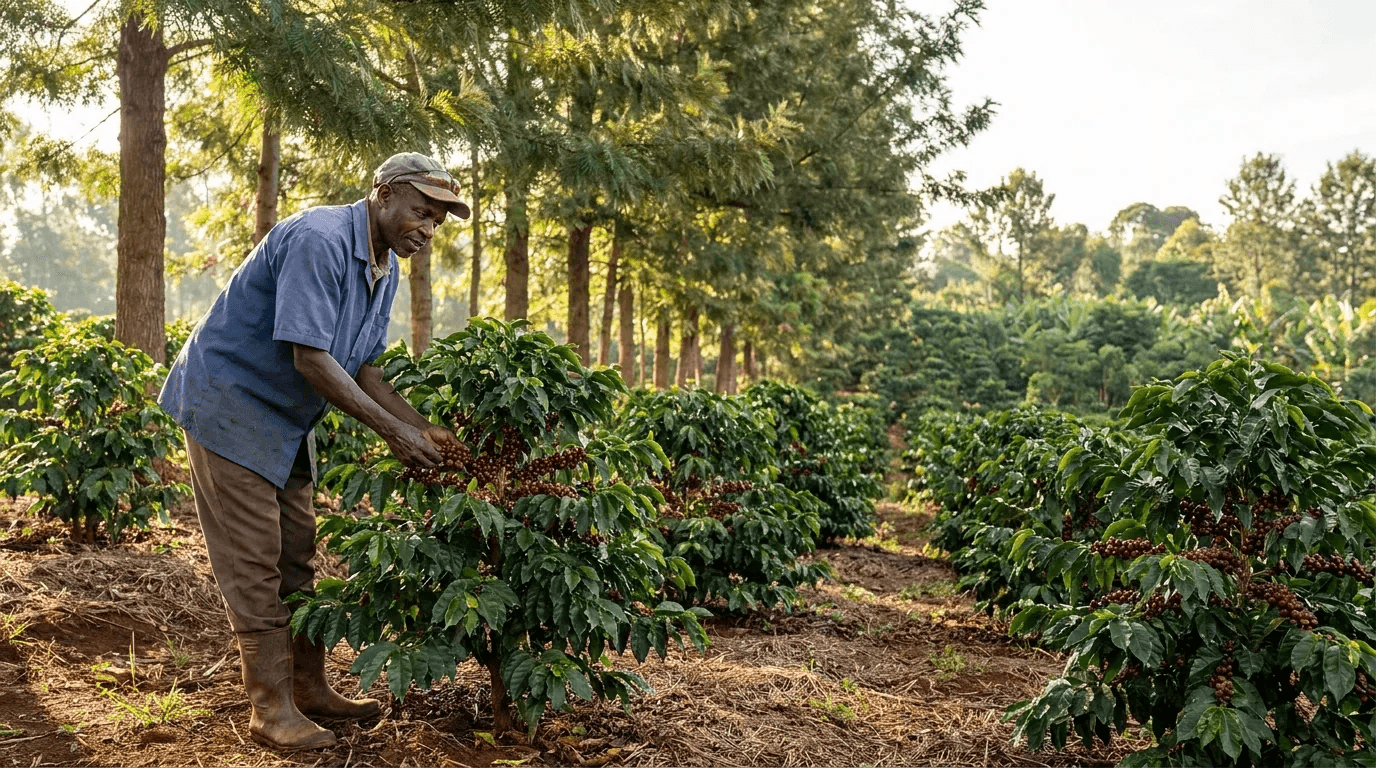
To establish Ruiru 11 at 1,200m–1,400m, plant at a 2m x 2m spacing (approximately 1,000 trees per acre), dig holes 60cm x 60cm x 60cm, amend with composted manure and phosphate fertilizer, and establish 30%–40% shade cover before the first rains.
Follow this establishment checklist:
Dig holes during the dry season, at least three months before the rains. Separate the top 15cm of topsoil from the subsoil.
Backfill one month before planting. Mix the topsoil with one debe (20 liters) of fully decomposed manure and 100g of Triple Super Phosphate (TSP).
Stick to the 2m x 2m spacing. This is the KALRO standard and allows adequate airflow, light penetration, and root expansion (Global Coffee Platform, 2021). Tighter spacings of 1.5m x 1.5m cause canopy closure by year three, which starves the lower bearing wood and traps humid air around the stem.
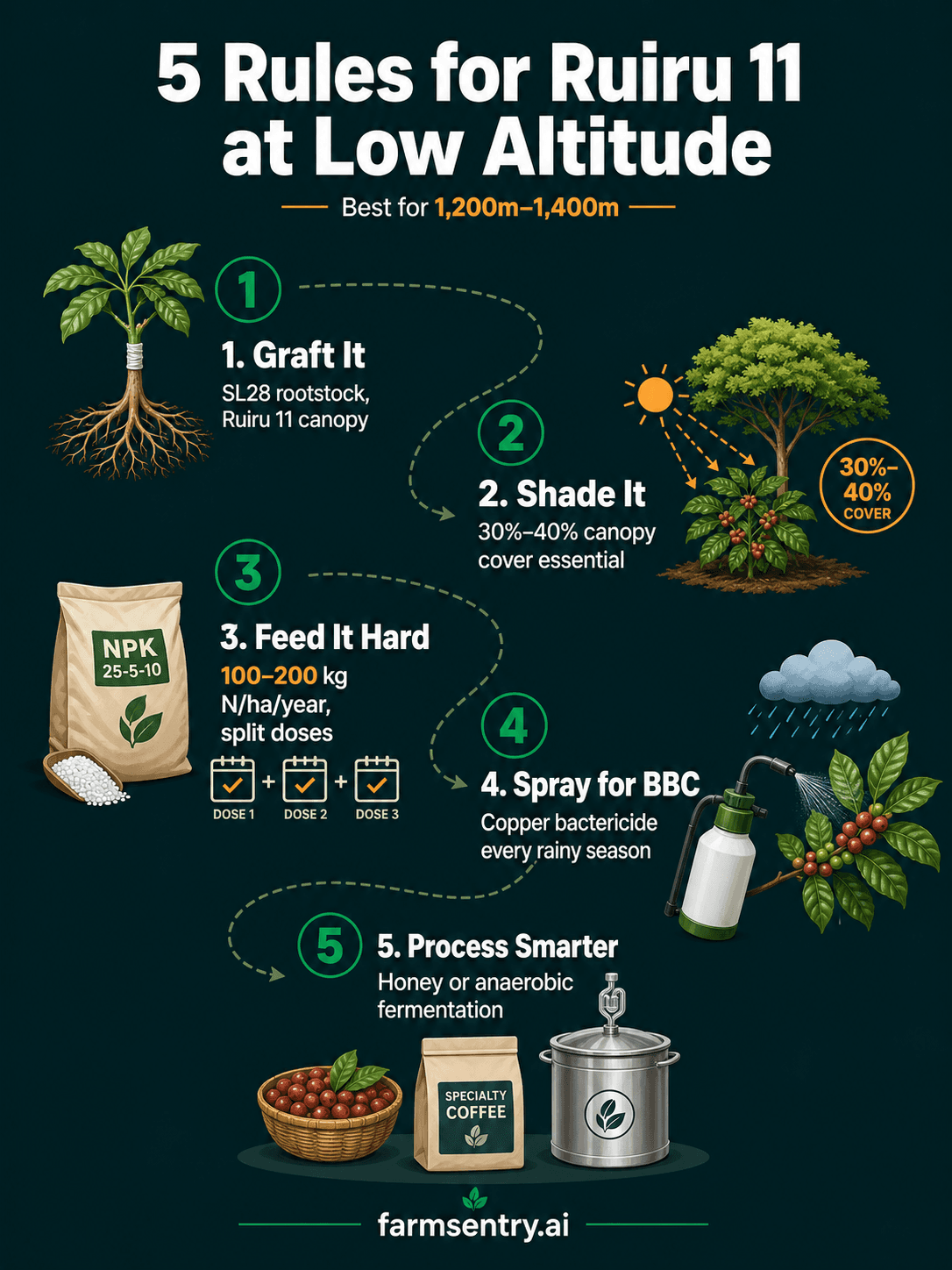
Plant shade trees before your coffee. At lower elevations, a 30%–40% regulated shade canopy is not optional. Species like Grevillea robusta or select Albizia varieties slow cherry ripening, reduce water demand, and claw back some of the bean density lost to the heat.
Use short-cycle intercrops in the first 18 to 24 months. Field beans, Irish potatoes, or tomatoes work well. Never intercrop maize directly within the coffee rows. Controlled research shows maize can depress young coffee yields by 59% to 100% through competition for light, water, and nitrogen (Experimental Agriculture, Cambridge University Press, 2003).
✅ Best Practice: Strip any flowers that appear before the 18-month mark. This forces the young tree to build root mass and structural wood instead of spending energy on premature fruit.
What Nutrition Does Ruiru 11 Need at Low Altitude?
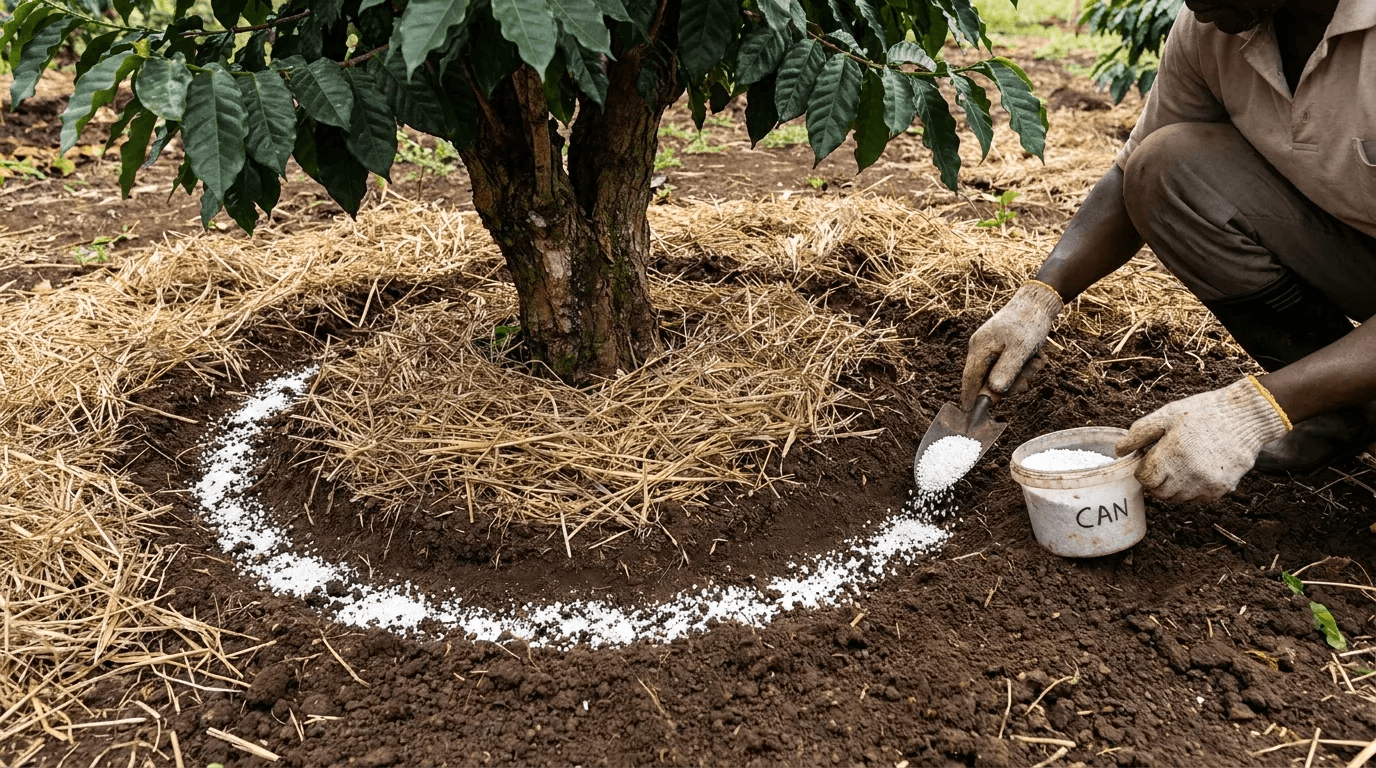
Ruiru 11 has a “Very High” nutritional requirement because its compact frame bears enormous crop loads and its shallow roots can’t mine deep subsoil reserves. At low altitude, nitrogen must be split across multiple applications to match the plant’s accelerated metabolism and prevent post-harvest dieback.
Use this as a starting framework for mature bearing trees:
Data adapted from KALRO extension parameters (Global Coffee Platform, 2021).
Apply nitrogen two weeks after the onset of the rains, then split further doses every three to four weeks to reduce leaching.
Two micronutrients deserve special attention at lower elevations. First, apply a foliar spray of Zinc and Boron two to three months before your main flowering. Use 40g–60g of each per 20 liters of water. Boron is essential for pollen tube growth. Without it, flowers open but fail to set fruit, a condition called “star flowering,” and you lose cherries before they even start.
Second, watch for interveinal chlorosis, the yellowing of leaves between the veins. This is a classic sign of magnesium deficiency, which is common in heavily weathered low-altitude soils and gets worse if you over-apply potassium.
⚠️ Common Mistake: Feeding Ruiru 11 like an SL28 tree. Because Ruiru 11 bears so heavily, skipping or under-applying nitrogen causes the tree to cannibalize its own leaves and branches to fill the cherries, resulting in severe post-harvest dieback.
Tracking fertilizer applications by hand across dozens of trees quickly becomes unreliable. A structured approach, like logging each application by date, rate, and row, helps you avoid missed doses and overapplication. Tools like FarmSentry’s activity logging let you record spray and fertilizer events in real time, so your records are accurate when you need to review what went wrong or scale what went right.
How Should You Prune Ruiru 11 for Maximum Production?
Prune Ruiru 11 using the uncapped multiple-stem system, maintaining 2–3 vertical bearing heads per tree. Remove all secondary branches within 6 inches (15cm) of the main stems to open airflow. Prune immediately after the main harvest and desuck every 3–4 months to prevent biennial bearing.
The 6-inch center-clearance rule is specific to Ruiru 11 and different from advice for traditional tall varieties (NKPCU, 2026). Because the plant is compact with densely packed branches, leaving the center closed creates a humid thicket that breeds Coffee Berry Borer and scale insects.
Biennial bearing is one of the most damaging economic problems Ruiru 11 farmers face. When a tree overbears in one season, it exhausts its carbohydrate reserves and produces almost nothing the following year. The fix is to limit each primary to no more than four non-cropping and two bearing secondary branches. This keeps the crop load balanced and the tree productive every single year (NKPCU, 2026).
Plan a complete stumping cycle after every five major cropping years. To avoid a zero-income year, begin the process 18–24 months early by clearing inner primaries to let light reach the base of the trunk, stimulating new suckers. Once suckers reach 18 inches, select the three to four strongest. Cut the old stems at a 45-degree angle just before the rains, allowing the new growth to take over.
💡 Pro Tip: Keep a log of each tree’s prune date and suckering history. Over three to four seasons, you’ll see a clear pattern of which rows tend toward biennial bearing, giving you the information you need to intervene earlier.
How Do You Protect Ruiru 11 from Pests and Disease at Low Altitude?
At 1,200m–1,400m, warmer temperatures accelerate pest reproduction. Prioritize Coffee Berry Borer (CBB) control through strict post-harvest sanitation, manage Antestia bug at very low thresholds, and apply copper-based bactericide during rains to protect against Bacterial Blight, which Ruiru 11 does not resist.
Coffee Berry Borer (CBB)
CBB is your biggest pest risk at lower elevations. Once the female bores inside the cherry to lay eggs, foliar sprays can’t reach her. The only reliable control is phytosanitary removal, called repase in East Africa. After every harvest, manually remove every overripe, dried, or mummified cherry from the tree and the ground. Mummified berries act as bridges between seasons, keeping the beetle population alive (USDA ARS, 2009). Maintaining 30%–40% shade also slows the beetle’s reproduction by reducing ground temperature.
Antestia Bug
Antestia bug feeds on developing cherries and causes the “potato taste” defect, a flavor fault that can render an entire export lot unsaleable. The economic injury threshold is one bug per tree in humid conditions (Naturland, 2024). Handpick in the early morning when bugs sun themselves on the upper canopy. For larger infestations, neem-based botanical sprays applied between April and June reduce populations without destroying natural predators.
Bacterial Blight of Coffee (BBC)
This is the critical blind spot for Ruiru 11 farmers. Ruiru 11 resists CBD and CLR effectively, but it’s highly susceptible to Bacterial Blight (Pseudomonas syringae pv. garcae), recording severity scores of 3.87 out of 5 in screening trials (Ithiru, 2016). BBC enters through mechanical wounds and causes dieback of bearing wood. Apply preventative copper-based bactericide sprays at the start of each rainy season. Assuming Ruiru 11 “requires no spraying” is one of the most expensive mistakes a low-altitude farmer can make.
🔍 Definition: Bacterial Blight of Coffee (BBC) is a bacterial disease, not a fungal one. Copper fungicides applied for CBD will also protect against BBC, but only if applied before infection takes hold.
Maintaining accurate spray and treatment records is easier when everything is in one place. FarmSentry’s activity logging allows you to track spray dates, chemical rates, and field coverage so you never guess when you last applied.
Can Grafting Fix Ruiru 11’s Weak Root System?
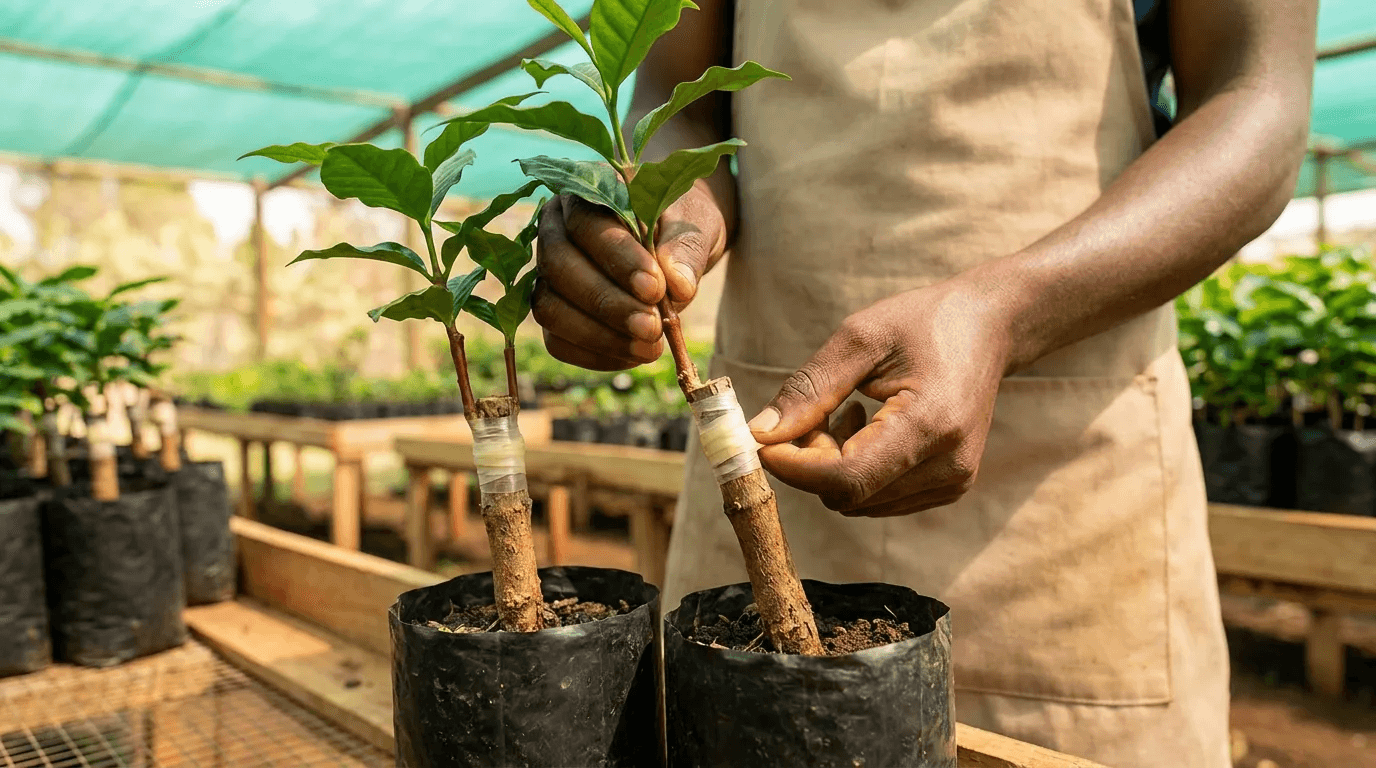
Yes. The recommended solution is to graft a Ruiru 11 scion onto an SL28 or Batian rootstock. This combines Ruiru 11’s compact, CBD-resistant, high-yielding canopy with the deep, drought-tolerant, nematode-resistant root system of SL28, making the tree far more viable at 1,200m–1,400m.
At lower altitudes, nematodes and drought are two compounding threats to Ruiru 11’s shallow roots. The grafted tree eliminates both problems at the soil level while retaining the full agronomic benefits of Ruiru 11 above ground.
For field renovation of existing SL28 trees:
Side-prune the SL28 to stimulate basal suckers
Allow suckers to grow for six months
Graft Ruiru 11 scions onto the suckers using whip-and-tongue grafting
Cover each graft with a small water-filled plastic tube to maintain humidity
After six months of healing, cut away the old SL28 main stem
The resulting tree behaves like Ruiru 11 in every visible way but draws from SL28’s massive, established root network.
📊 By the Numbers: At the 2m x 2m recommended spacing, a well-managed grafted Ruiru 11 field can produce 10,000–15,000 kg of cherry per acre annually, translating to roughly 1,400–2,100 kg of clean green bean per acre (Global Coffee Platform, 2021).
How Do You Improve Ruiru 11’s Cup Quality at Low Altitude?
Improve Ruiru 11 cup quality at low altitude by using honey or anaerobic fermentation processing. These methods introduce the sweetness and aromatic complexity the bean lacks genetically at lower elevations, pushing cup scores from 80–82 up toward the 85–88 SCA range.
Let’s be honest: washed Ruiru 11 at 1,200m often tastes flat next to its high-altitude counterparts. The accelerated ripening process reduces the time available for complex sugar and acid development in the seed. Two processing strategies compensate for that:
Honey Processing: Depulp the cherry, skip fermentation and washing, and let the sticky mucilage dry directly on the parchment. This drives sucrose into the bean, creating heavy caramel and brown sugar notes that complement Ruiru 11’s natural body.
Anaerobic Fermentation: Seal depulped cherries in oxygen-deprived tanks for 32–72 hours. Lactic acid bacteria synthesize novel esters and tropical fruit notes that lift the SCA score well beyond what the variety achieves in standard washed processing.
Tracking processing batches, fermentation times, and drying durations by farm block gives you the data to repeat your best results. Using FarmSentry’s financial management tools to link your processing costs to each lot’s yield helps you calculate the true return on specialty processing investment.
Conclusion and Action Plan
Growing Ruiru 11 coffee at low altitude is demanding work. But the rewards are real. A well-managed grafted Ruiru 11 field at 1,200m–1,400m can outperform an unmanaged SL28 plantation at 1,600m, both in volume and, with the right processing, in cup quality.
Key Takeaways
- Graft onto SL28 or Batian rootstock. Ruiru 11's shallow roots are its biggest liability at low altitude. Grafting is the single highest-impact decision you can make.
- Feed aggressively and precisely. Nitrogen at 100–200 kg/ha per year, split across multiple applications, plus Zinc and Boron foliar sprays before flowering, are non-negotiable at this elevation.
- Never skip Bacterial Blight protection. Ruiru 11 resists CBD and CLR, but BBC will kill your bearing wood if you stop spraying copper during the rains.
Implementation Roadmap
This week: Test your soil pH and review your last fertilizer application dates. Identify any overripe or mummified cherries left in the field and remove them immediately.
This month: Source certified F1 Ruiru 11 seedlings from a registered nursery if you're establishing new rows. Identify your shade tree gaps and plan infill planting.
This season: Set up a drip irrigation system along at least one block of your farm. Compare cherry set and dieback rates in irrigated vs. non-irrigated sections. Use that data to justify expansion.
Every season: Log every fertilizer application, spray event, and prune date. You can't improve what you can't measure. [FarmSentry's dashboard and analytics](/features/dashboard) gives you a real-time view of your farm activities and tracks patterns across seasons, so you spend less time guessing and more time acting.