Soil Testing in Kenya: What to Check Before You Buy Maize Fertilizer
You bought the same bags of DAP and CAN as last season. You planted on time. The rains were fair. The harvest still came in smaller. The usual answer is to buy more fertilizer next season. Often the better answer is to find out what your soil is short of before you spend again. A soil test can show whether your field needs acidity corrected, different nutrients or a closer look at something else. But a lab sheet on its own changes nothing. What you need from it is a plan: what to apply, how much, where and when. Field-specific advice of this kind is what the guidance behind this article supports, although no study promises a fixed yield gain or saving from testing alone (“Optimizing Fertilizer Efficacy Through Soil Diagnostics,” undated).
Why more fertilizer may not solve the problem
Soil pH measures how acidic or alkaline soil is. In strongly acidic soil, aluminium becomes available in forms that damage roots, and phosphorus binds to iron and aluminium so maize struggles to take it up. Adding more phosphorus then does little about the real limit on growth (“Liming remediates soil acidity and improves crop yield and profitability,” 2023). This does not mean DAP never works, or that every poor field needs lime. Fertilizer supplies nutrients. Agricultural lime corrects acidity. A field may need both, one or neither, and only its own condition can tell you which.
Poor returns can also come from compacted soil, poor drainage or disease, and a routine fertility test diagnoses none of these. If maize does badly in wet hollows, or roots cannot push deeper, ask for a field inspection alongside the test (“Optimizing Fertilizer Efficacy Through Soil Diagnostics,” undated).
Arrange a test that can guide a purchase
Before collecting soil, contact the laboratory or the extension officer helping you. Tell them you grow maize, your fertilizer returns are low and you suspect acidity.
Then ask:
- What does the test cover? Confirm it includes pH and useful nutrient measurements. Do not assume every package is complete.
- Will you interpret the results for maize? Ask whether the price includes a written recommendation.
- How should I sample and pack the soil? Confirm depth, quantity, drying and delivery.
- When will the advice be ready? You need time to act before planting.
- What is the full cost? Include collection, delivery and interpretation.
The most useful measures are pH, available nutrients, organic matter and CEC. Organic matter is material from decomposed plants and animals. CEC describes how well the soil holds on to certain nutrients. Salinity, or excess salt, can also matter, but packages differ, so ask (“Optimizing Fertilizer Efficacy Through Soil Diagnostics,” undated). Start early. The Soil Testing Guide Kenya recommends sampling two to three months before planting (CropGenius, undated). Take that as a planning guide, not a promise that lime will have finished working by then. Lime needs moisture and time to react, so ask your adviser how your local season affects timing.
Collect soil that represents the field
A laboratory can only measure the soil you send. If it comes from an unusual spot, the advice may not fit the rest of the field.
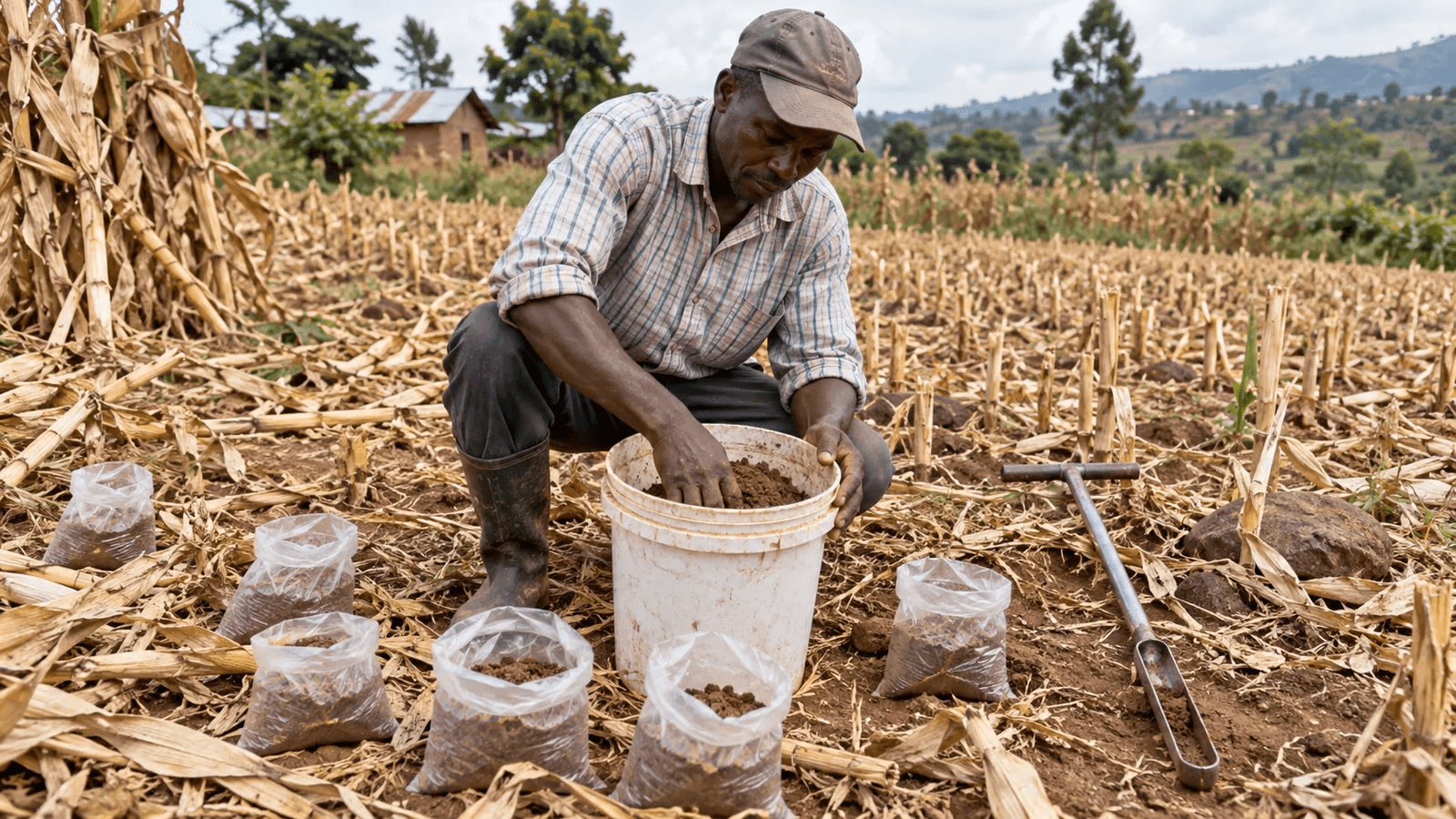
Before you start: have the laboratory’s instructions, a clean sampling tool, a clean non-galvanized plastic bucket (galvanized metal can add zinc to the sample), sample bags and labels.
Follow these steps, adjusting them to your laboratory’s instructions:
1. Separate clearly different areas. Keep fields or zones with different soils, past management or crop performance apart. Do not mix a poor patch with a better area if you want advice for each.
2. Walk each similar area in a zigzag or W pattern. Spread your collection points across the area instead of sampling beside the gate.
3. Take several small samples. Combine 15 to 20 subsamples for each uniform area.
4. Keep the depth the same. 0 to 20 cm is the usual depth for maize. Confirm it with your laboratory.
5. Avoid unusual spots. Leave out old ash piles, animal droppings, fertilizer bands, anthills and eroded gullies.
6. Mix thoroughly in the clean bucket. This makes a composite sample: one mixed sample that stands for the whole area.
7. Pack and label as instructed. Write the field or zone, collection date and depth, so the result can be matched to the right land.
These steps follow published sampling guidance for East African farms (“Optimizing Fertilizer Efficacy Through Soil Diagnostics,” ).
Final check: can you point to the area each bag represents? If not, fix the labels before sending. If an odd patch is the problem you want investigated, send it as a separate sample rather than hiding it in the field average.
Write the same details down somewhere that will outlast the bag label: field, date and depth. You will need them when the results arrive, and again in two or three years when you test the same field and want to compare. In FarmSentry, you add the soil test to the field itself, with its sample date, so the lab report comes back to the right land.
Turn the report into a lime and fertilizer decision
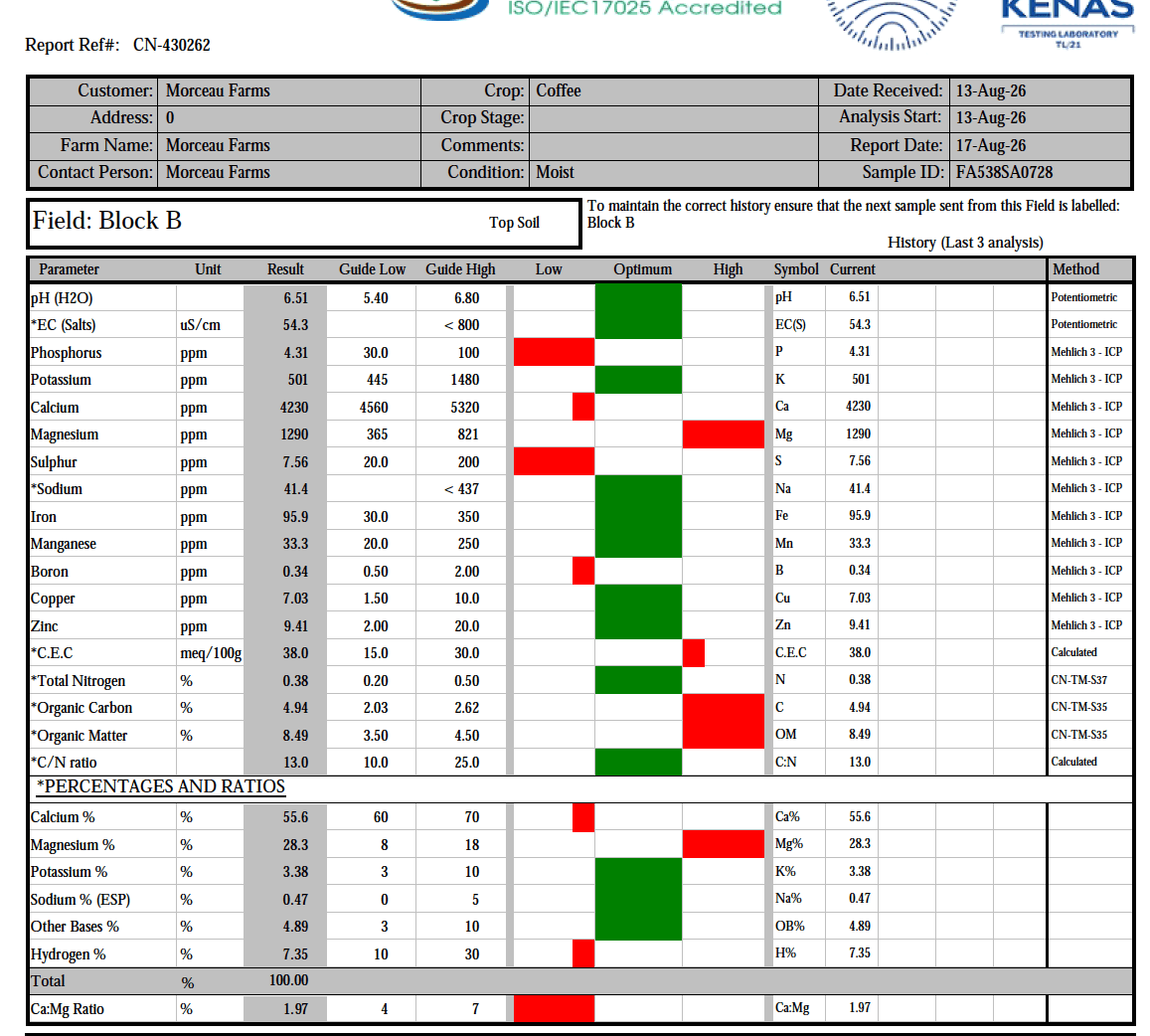
Ask the laboratory or agronomist to explain, in plain language, the main thing holding your maize back. Then work through these checks.
Check the pH method
Ask: “Was pH measured in water or calcium chloride?”
The two methods give different readings from the same soil, and calcium chloride readings are generally lower. Never compare two reports as if the method were the same, or judge lime need from a number without knowing its method (*Understanding soil pH*, undated).
Do not use pH alone to choose a lime rate
Two soils with the same pH can need very different amounts of lime. Clay content, organic matter and buffering capacity all matter. Buffering capacity is how strongly a soil resists a change in pH. Ask whether the rate takes account of your field and the lime product you are being offered. A neighbour’s rate is not enough reason to buy (“Optimizing Fertilizer Efficacy Through Soil Diagnostics,”).
Ask which type of lime fits the result
Where the soil is acidic and also low in magnesium, an adviser may recommend dolomitic lime, which supplies calcium and magnesium. Where magnesium is already adequate, calcitic lime may suit better. Ask the adviser to tie the choice to your test, not to the bag price (CROPNUTS).
Get a complete nutrient plan
Correcting acidity does not supply every nutrient maize needs. Ask which nutrients are low, which are adequate, and which fertilizers you can actually buy that fit the result. Phosphorus readings also depend on the lab method. If two reports disagree, ask about their methods before deciding the field has gained or lost phosphorus (“Optimizing Fertilizer Efficacy Through Soil Diagnostics,” undated).
Before buying anything, get a written plan with:
- The field or zone name.
- Product type and application rate.
- Clear units, such as kilograms per acre or per hectare.
- Timing and application instructions.
- The most important action if you cannot afford the full plan.
Keep the lab’s advice separate from any explanation
Many lab reports are hard to read: a page of numbers, units and abbreviations, with the advice in small print at the bottom. Getting help to understand them is sensible. The risk is help that quietly changes the numbers.
Whoever explains your report, an agro-dealer, a friend or an app, the amounts should still come from the lab or your agronomist, who know your soil and the products being used. Be wary of any lime or fertilizer rate that does not appear on the report.
FarmSentry Soil Testing is built around that rule. Upload the lab’s PDF or a photo of the report, and FarmSentry reads the values for you to check one by one before anything is saved. It then writes a short report for that field in plain language with two separate parts:
- What your lab recommends: the lab’s own advice, with amounts copied exactly as printed.
- What FarmSentry recommends: one to three practical next steps, each marked against what the lab said.
FarmSentry never works out a lime or fertilizer amount of its own. If the lab printed no rate, the report says so and leaves the rate to your agronomist.
Compare the whole cost, not just the input price
Lime is bulky, so transport and labour can cost as much as the lime itself. Buying, haulage, finding stock and spreading are all real barriers for smallholders. Put them in the decision before you order, not after the lorry arrives (“Optimizing Fertilizer Efficacy Through Soil Diagnostics,” undated).
Ask for two costed options:
1. Full recommended plan. Get the total cost of testing, lime, fertilizer, delivery and application.
2. Affordable phased plan. Find out which action comes first, what can wait, and what that delay costs you.
Do not simply halve every recommended rate. Ask the agronomist which problem deserves the money first.
For your own budget, work out your break-even price:
Break-even maize price = total production cost ÷ saleable maize harvested
Use kilograms for the harvest if you want the answer in KES per kilogram. Use a cautious harvest estimate, not your best-ever season.
A worked example, with made-up numbers: if growing an acre costs you KES 60,000, including the share of lime and testing, and you expect to sell 20 bags of 90 kg (1,800 kg), your break-even price is about KES 33 per kilogram. If the buyer’s price is below that, the plan needs to change before you spend.
A hypothetical decision: the advice says lime plus a change of fertilizer, but delivered lime costs more than you expected. The next step is to ask for a phased plan and what it gives up, not to buy a small, random amount of lime and hope for the full effect.
Make sure the advice gets done
This is where most soil tests fail. The report arrives, everyone agrees with it, and planting season takes over. A test does not improve soil by itself. The benefit comes from the change you make after it.
Give every action in the plan three things: a date, a person and a field. “Spread lime on the lower field by 15 February, Peter” is a plan. “Lime the farm” is a wish.
In FarmSentry, each step in your soil report can become a task with one tap. You review the title, due date and who it is assigned to before saving, and the task stays linked to the field and the report it came from. Your farm team sees it in their task list instead of relying on someone remembering a conversation.
Keep the report, input receipts, application dates and harvest weights together. Next season you can see what you changed, and avoid crediting the treatment for what was really the weather.
What the evidence does not promise
The research behind this guide combines laboratory guidance, trials and surveys. It is not a recommendation for your farm, and some of the guidance is undated. Three limits matter:
- No national acidity figure diagnoses your field. Commercial soil-test data come from samples farmers chose to send, which may not represent every Kenyan farm.
- No published gain is your guaranteed return. Weather, starting soil, input prices and how well inputs are applied all change the outcome.
- Trial results vary. Summaries of some trials disagree, which is why this guide does not promise a yield increase, profit or fixed lime rate (“Optimizing Fertilizer Efficacy Through Soil Diagnostics,” undated).
Next Steps
Before your next big fertilizer purchase:
1. Contact a laboratory or extension officer. Confirm the test package, sampling instructions, cost and turnaround time.
2. Sample each similar area carefully. Label every bag with the field, date and depth.
3. Take the results and your budget to an agronomist. Leave with a written, costed plan, including what to do first if money is short.
Then make sure the plan happens: date each action, give it to someone and record what you applied.
Keep every soil test in one place
FarmSentry Soil Testing stores each lab report against its field, reads the results for you to check, writes a plain-language report that keeps your lab’s advice word for word, and turns the next steps into tasks your team can see. It reminds you when each field is due for its next test. Soil Testing is part of FarmSentry Premium, and every plan can open an example to see how it works.
References
- Optimizing Fertilizer Efficacy Through Soil Diagnostics: A Research Brief for East African Agriculture. Undated. Supplied research synthesis; author and public URL not provided. Used for sampling, decision guidance and evidence limitations.
- CropGenius. Undated. [*Soil Testing Guide Kenya: Complete Guide to 25-40% Yield Increase*](https://cropgenius.africa/blog/soil-testing-guide-kenya). Guidance summarized in the supplied research brief.
- Liming remediates soil acidity and improves crop yield and profitability. 2023. Frontiers in Agronomy. [Article](https://www.frontiersin.org/journals/agronomy/articles/10.3389/fagro.2023.1194896/full). Findings summarized in the supplied research brief.
- Understanding soil pH. Undated. [Guidance document](https://www.dpi.nsw.gov.au/__data/assets/pdf_file/0003/167187/soil-ph.pdf). Measurement guidance summarized in the supplied research brief.
- CROPNUTS Helpdesk. Undated. [*Interpreting your soil test results*](https://cropnuts.helpscoutdocs.com/article/829-interpreting-your-soil-test-results). Guidance summarized in the supplied research brief.