Boer Goat Farming Guide for Africa: Build a Profitable Meat Goat Enterprise | FarmSentry Blog | FarmSentry
Written by Claud Fields
April 22, 2026Apr 22, 2026
12 min read
Animals
Boer Goat Farming Guide for Africa: Build a Profitable Meat Goat Enterprise
In short
Start and scale a Boer goat enterprise in East or Southern Africa using smart crossbreeding, targeted feeding, and proactive health management. Hit weaning rates of 150% and above. Here's exactly how to do it.
Introduction
Goat meat is one of the most eaten animal proteins across Africa. Yet most farmers are still selling underweight, slow-growing local goats at a fraction of what a good crossbred animal would fetch at the gate.
Here’s the core problem: plenty of farmers know the Boer goat puts on more meat. But they don’t know how to get started, how to crossbreed properly, or how to manage a herd well enough to make consistent money.
This Boer goat farming guide for Africa gives you a clear, practical roadmap. You’ll learn how to pick foundation stock, set up housing, feed for fast growth, stay ahead of disease, and keep records that tell you exactly what’s working and what isn’t.
Whether you’re starting with 10 does or scaling to 100, this guide gives you what you need to run meat goat farming as a serious, sustainable business.
What Is a Boer Goat and Why Is It the Best Meat Breed in Africa?
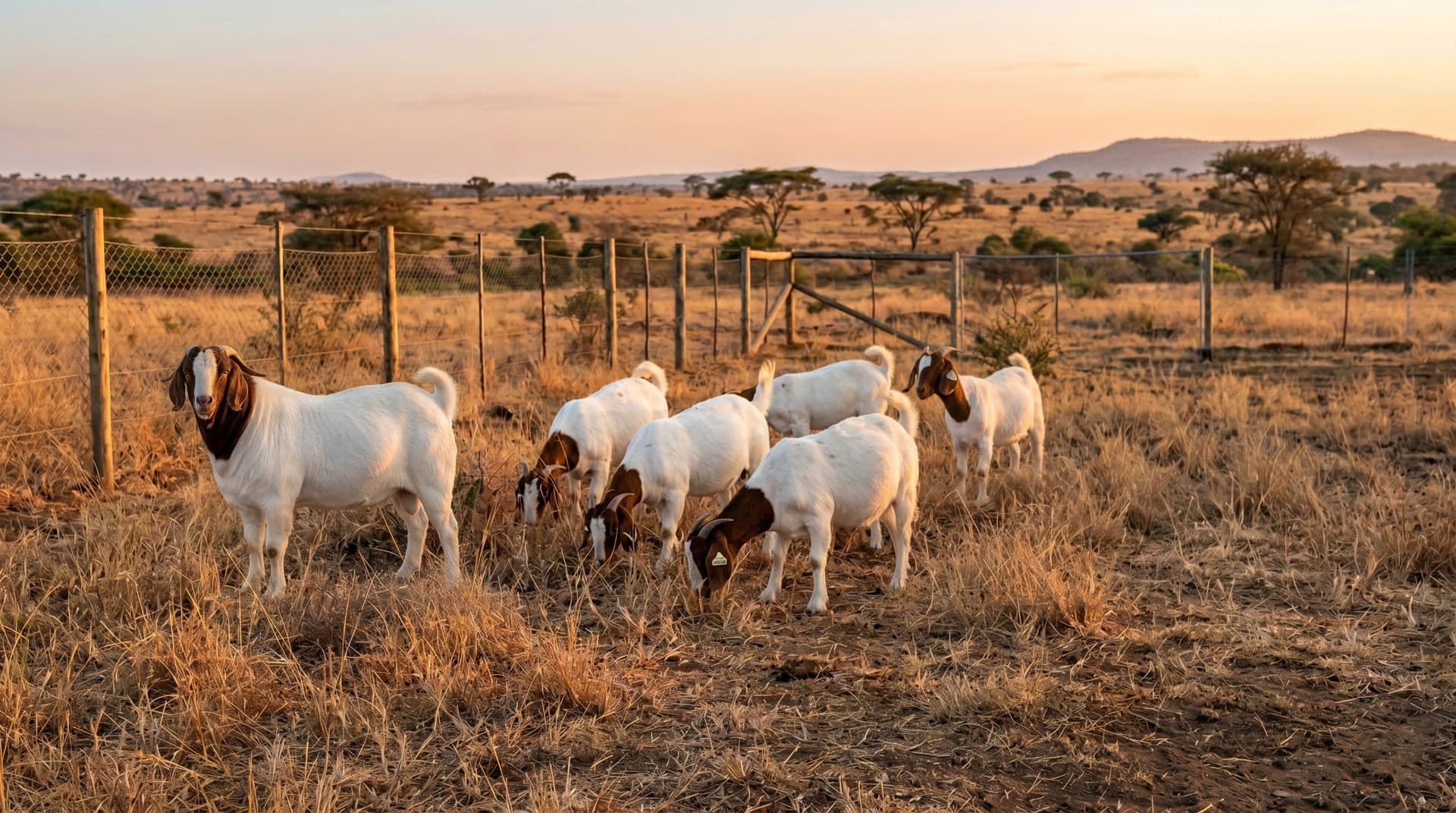
The Boer goat is the world’s leading commercial meat goat breed. It was developed in South Africa in the early 1900s through selective breeding of indigenous African goats, Indian breeds, Angora goats, and European dairy goats .
The name “Boer” comes from the Dutch and Afrikaans word for “farmer” . The breed was formally standardized in 1959 when the Boer Goat Breeders Association of South Africa was established .
So how does the Boer goat actually compare to what most farmers already have?
The Small East African goat, common in Kenya, Uganda, and Tanzania, tops out at a mature weight of only 25 kg to 35 kg . A mature Boer buck, by contrast, reaches 110 kg to 135 kg. Does range from 86 kg to 104 kg .
Under good feeding and management, Boer goats put on 200 to 300 grams per day. They can reach a marketable live weight of 30 kg to 35 kg in around five months .
🔍 Definition: Average Daily Gain (ADG) is the amount of weight an animal gains per day. You calculate it by dividing total weight gained by the number of days in the measurement period.
✅ Best Practice: In humid, high-rainfall regions of East Africa, go with F1 or F2 crossbreds rather than fullblood Boer goats. Local genetics carry critical resistance to hoof rot and internal parasites .
How Much Money Can You Make from Boer Goat Farming?
Demand for quality goat meat, called chevon or cabrito, is large and still growing. It peaks sharply during Eid al-Adha and Christmas but stays strong year-round through restaurants, hotels, and export channels .
📊 By the Numbers: In Kenya, commercial crossbred Boer goats sell for approximately KES 1,200 per kilogram of live weight. Pure Boer genetics command KES 3,000 to KES 4,000 per kilogram . High-quality mature bucks can fetch KES 240,000 to KES 400,000 .
A starter herd of 20 does, managed well, can generate a net profit of approximately KES 4,500 per doe per year. Over 36 months, that same herd can grow to over 80 animals and generate upwards of KES 1.2 million in cumulative revenue .
Operations running on natural pasture with F1 crossbred does typically break even within 18 to 24 months . More intensive, pure-stud operations may take 36 to 48 months, but their long-term profit ceiling is much higher .
💡 Pro Tip: Cut out informal livestock market middlemen where you can. Selling directly to butcheries or restaurants pushes your net margin per animal up by 15% to 20% .
Tracking your real costs and revenue per animal isn’t optional. A financial management system that links feed costs, veterinary bills, and labor to individual animals gives you accurate cost-per-head figures so your decisions are based on facts, not guesses.
How Do You Start a Boer Goat Herd from Scratch?
The recommended starting herd size for smallholder farmers is 10 to 20 does plus one quality Boer buck . Commercial operators with more land and capital may start with 50 to 100 does using multiple bucks .
The standard buck-to-doe ratio for natural mating is one mature buck for every 20 to 30 does . Artificial insemination is an option, but it needs specialized veterinary support and precise timing. Natural service is still the most practical and affordable choice for most African farmers .
Where to source quality breeding stock:
In Kenya: Tharaka Nithi, Meru, Laikipia, Nakuru, and Kajiado regions host reputable Boer breeding hubs .
In South Africa: Buy from registered breeders affiliated with the Boer Goat Breeders Association of South Africa .
In Zimbabwe: The Goat Breeders Association of Zimbabwe (GBAZ) connects buyers with inspected, registered stud animals .
⚠️ Common Mistake: Never buy stock from communal sale yards where animals from multiple farms are mixed. Transport stress plus exposure to new pathogens almost guarantees you’ll import respiratory disease or foot rot into your new herd .
🎯 Key Takeaway: Your foundation buck is your most important purchase. Ask to see his sire and dam. A buck passes on his parents’ traits, so checking his mother’s udder and his father’s frame tells you a lot about what your future herd will look like .
For buck selection, check scrotal circumference: a 7-month-old buck should measure at least 26 cm to 29 cm, growing to over 33 cm by 12 to 18 months . Firm, symmetrical testicles free of lumps are non-negotiable .
What Should You Feed Boer Goats for Maximum Growth?
Feed costs run to about 60% of total production costs in small ruminant enterprises . Getting nutrition right is genuinely the difference between profit and loss.
Unlike sheep that prefer short grass, Boer goats are natural browsers. They go for leaves, shrubs, and broadleaf weeds over grass . On rangeland, rotational grazing protects browse species and breaks parasite lifecycles by moving goats away from their own feces .
Feed requirements change by life stage. Dry does need only basic maintenance. In the final 50 days of pregnancy, growing fetuses compress the rumen and reduce feed capacity. Does then need concentrated, energy-dense feeds with at least 70% Total Digestible Nutrients (TDN) and 16% Crude Protein to avoid a dangerous condition called pregnancy toxemia .
A mature Boer goat needs 7 kg to 9 kg of fresh green matter daily to meet its dry matter needs .
Cost-effective feed ingredients commonly used in East and Southern Africa:
Maize bran or maize germ: approximately KES 1,800 to KES 2,100 per 50 kg
Sunflower cake: approximately KES 2,700 per 50 kg
Cottonseed cake: approximately KES 3,150 per 50 kg
Lucerne (alfalfa) hay: premium protein-rich roughage for zero-grazing systems
African soils, especially in the Great Rift Valley, are often short on copper, selenium, and phosphorus . Always put out goat-specific loose trace minerals or mineral salt blocks with elevated copper and a 2:1 calcium-to-phosphorus ratio, available free-choice year-round .
📊 By the Numbers: Body Condition Score (BCS) guides your feeding decisions. A score of 3.0 to 3.5 is the target for breeding does and bucks going into the mating season . Scores below 2.0 signal a serious nutrition or parasite problem .
⚠️ Common Mistake: Never introduce high-starch grain rations suddenly. Bring them in gradually over 14 to 21 days. A sudden switch causes lactic acidosis and can trigger fatal Enterotoxemia .
How Do You Manage Boer Goat Health and Prevent Disease?
Staying ahead of disease is the foundation of profitability. Treating sick animals reactively always costs more than keeping them healthy in the first place .
The most economically damaging diseases in East and Southern Africa include:
PPR (Goat Plague): A highly contagious viral disease that can wipe out an entire herd. One subcutaneous vaccination provides lifelong immunity and is absolutely mandatory in East Africa .
Enterotoxemia (Pulpy Kidney): Strikes fast-growing kids on sudden grain or lush pasture transitions. Prevent it with CDT vaccination .
Heartwater: A fatal tick-borne disease. Control depends on strategic dipping to eliminate the Amblyomma tick vector .
Pneumonia: Triggered by poor ventilation and cold stress .
Foot Rot: Thrives in wet, muddy pens. Prevent it with dry, slatted floors and hoof trimming every six weeks .
Internal parasites, especially the Barber Pole worm (Haemonchus contortus), are the greatest ongoing threat to your herd . Drug resistance is a serious crisis across Africa, driven by years of dewormer overuse .
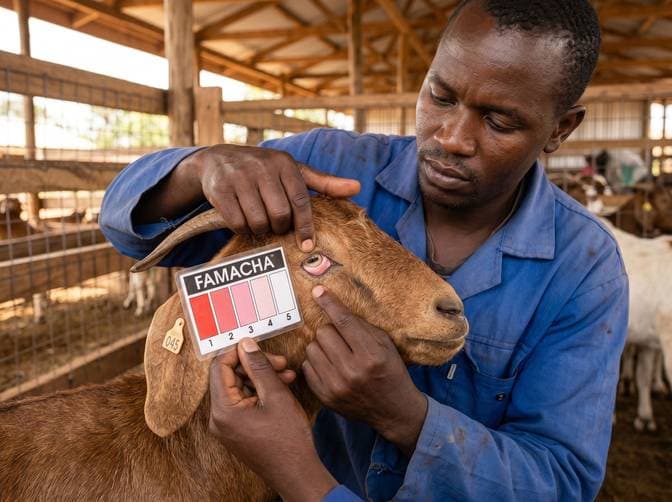
🔍 Definition: The FAMACHA method involves pulling down a goat’s lower eyelid and matching the color of the mucous membrane to a 5-point chart. Only pale or white-eyed animals get treated. This protects refugia, which are unexposed worm populations that slow the spread of drug resistance .
✅ Best Practice: Don’t rotate dewormer classes every time you dose. Use one class until it stops working, then switch. Rapid rotation speeds up multi-drug resistance .
Keeping up with vaccination schedules, FAMACHA scores, and treatment histories across a growing herd is hard on paper alone. FarmSentry’s health tracking module lets you log treatments, set vaccination reminders, and pull up a complete animal health history instantly, so nothing gets missed.
The Smartest Breeding Strategy: Crossbreeding for Profit
For most commercial farmers in East, Central, and West Africa, crossbreeding is the most profitable and practical path forward . You run a pure Boer buck over hardy local does to produce offspring that carry the best traits of both breeds.
This genetic boost is called hybrid vigor or heterosis. F1 crossbred kids inherit heat tolerance and disease resistance from their indigenous mother, and rapid growth and heavy muscling from their Boer father . F1 crossbreds are also more active at birth and quicker to find the teat than pure Boer kids, which improves early survival under tough conditions .
Understanding the upgrading generations:
GenerationBoer BloodBest UseF150%Maximum hybrid vigor; ideal for harsh, low-input commercial slaughterF275%Excellent balance of size and hardiness; ideal commercial breeding doeF387.5%Heavy carcass; requires better nutrition and housingF4+93.75%+Near-purebred; susceptible to local diseases; high input required
💡 Pro Tip: In extremely harsh or drought-prone areas, stabilize at the F1 generation. Keep breeding pure Boer bucks to 100% indigenous does. This locks in maximum hybrid vigor and strong survival rates every year .
⚠️ Common Mistake: Never keep an F1 or F2 crossbred buck for breeding. He’ll pass on inconsistent genetics to his offspring. Always use a pureblood registered Boer buck over your crossbred does .
Managing breeding calendars, tracking gestation dates, and recording offspring lineage across multiple generations gets complicated fast. FarmSentry’s breeding and reproduction module lets you schedule mating events, monitor gestation progress, and link kids to their sire and dam so you always know exactly what genetics you’re working with.
How Do You Keep Records That Actually Grow Your Business?
Farming without records is guesswork. Records turn a hobby into a business.
Every animal needs a unique identifier. Use a numbered ear tag matched to a permanent tattoo in case the tag gets torn out . Color-coding tags by birth year, say red for 2024 and blue for 2025, lets you estimate an animal’s age at a glance .
The minimum records every Boer goat farmer must maintain:
Breeding and kidding dates, litter sizes, and birth weights
Weight records at birth and weaning
Vaccination dates, deworming records, drug withdrawal times, and disease incidence
Daily feed costs, veterinary expenses, and sales income
Key Performance Indicators (KPIs) to track:
ADG Formula: (Final Weight minus Initial Weight) divided by Number of Days
A kid born at 3 kg and weighing 21 kg at 90 days has an ADG of 200 grams per day. That tells you the genetics and nutrition are both doing their job .
Weaning Rate Formula: (Number of Kids Weaned divided by Number of Does Exposed to Buck) multiplied by 100
A weaning rate of 145% to 160% means you’re running a highly profitable, well-managed herd .
Mortality Rate: Target below 10% for commercial operations .
🎯 Key Takeaway: Use your records to cull the bottom 15% of underperforming does each year. Cut animals that consistently wean single, slow-growing kids, carry heavy parasite loads, or need repeated help at kidding .
FarmSentry’s livestock management module lets you track individual animal weights, breeding records, and health data in one place. Pull performance reports per animal or per contemporary group, and make culling decisions based on real data rather than gut feel.
Conclusion and Action Plan
Boer goat farming in Africa is a real business opportunity. The demand is there. The genetics are accessible. What separates profitable operations from struggling ones is deliberate setup, consistent health management, and disciplined record-keeping.
Key Takeaways:
- F1 and F2 crossbreds give you the best balance of growth, hardiness, and profitability for most commercial East and Southern African farms.
- Feeding and parasite management are your two highest-impact activities. Get these right and your costs drop while your growth rates climb.
- Records aren't paperwork. They're your decision-making engine. Track ADG, weaning rates, and cost-per-head from day one.
Your Implementation Roadmap:
1. This week: Define your business model. Decide between commercial slaughter crossbreds or elite stud production. This single choice drives every capital decision that follows.
2. In the next 30 days: Visit two or three registered breeders. Assess bucks using scrotal circumference and structural soundness. Buy the best buck your budget allows.
3. Before your first animal arrives: Build or modify housing with slatted, elevated floors. Secure the perimeter fence. Set up a quarantine pen at least 50 meters away from your main shed.
4. In the first 90 days: Set up your record-keeping system, whether digital or paper. Tag every animal. Start FAMACHA scoring weekly. Build a working relationship with a local livestock veterinarian.