How Picking Decides Coffee Quality: A Harvest Playbook for Commercial Farms | FarmSentry Blog | FarmSentry
Written by Claud Fields
May 29, 2026May 29, 2026
13 min read
Coffee
How Picking Decides Coffee Quality: A Harvest Playbook for Commercial Farms
In short
Coffee harvesting best practices start at the tree. Pick at peak Brix, process within 24 hours, and log every lot by block and team. One bad batch can cost you specialty grade status. ---
Introduction
What if the most expensive decision on your farm happens in under two seconds? That’s how long it takes a picker to grab a cherry and drop it in a bag. Get that moment right across thousands of trees and you’ve got a specialty lot. Get it wrong and you’ve got a rejected shipment, a frustrated buyer, and a full season of hard work written off.
Here’s the thing: most post-harvest problems start in the field, not at the wet mill. By the time a sour bean, a quaker, or a fungal defect shows up in a sorting tray, the mistake was already made at the tree, on the drying table, or in the transport bag.
This playbook gives farm managers, harvest supervisors, and washing-station operators a step-by-step system for applying coffee harvesting best practices. You’ll learn how to read cherry ripeness, choose the right picking method, manage picker behavior, handle cherries after they leave the tree, and build a traceability record that buyers and regulators will trust.
How Do You Know When Coffee Cherries Are Ready to Pick?
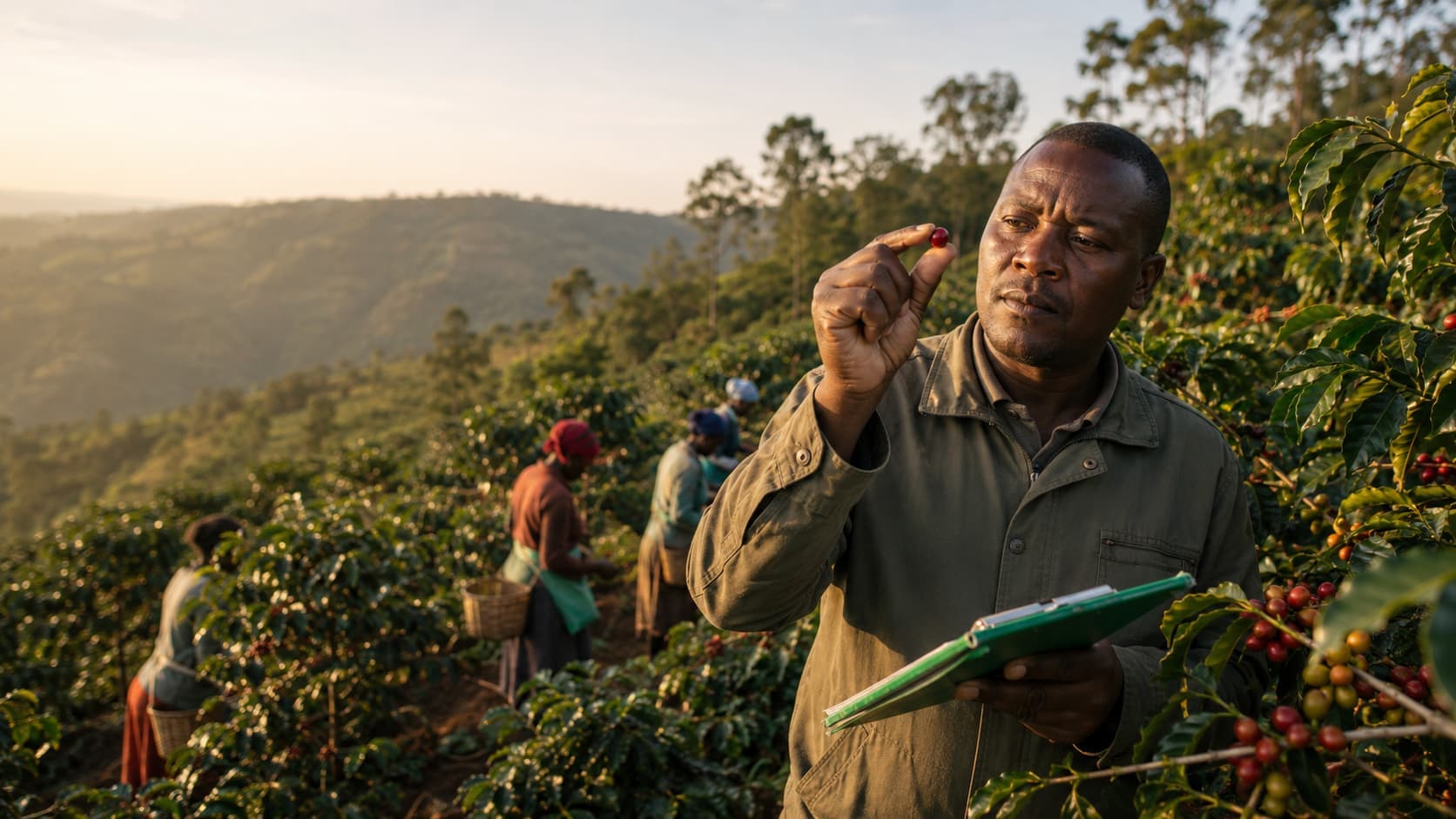
Direct Answer: A coffee cherry is ready to pick when it reaches peak physiological ripeness, shown by full, uniform color (deep red, golden yellow, or consistent pink depending on variety) and a Brix reading of 18 to 24 percent on a handheld refractometer. At this stage, the cherry detaches cleanly with minimal force.
Relying on color alone is risky. Shade-grown yellow varieties can appear pale even when fully ripe. Pink Bourbon cherries may still look greenish at their peak. Color is a starting point, not a final answer.
The Brix test fills the gap. A refractometer measures the sugar concentration in the cherry’s mucilage juice. Target 18 to 24 percent Brix for specialty standard fruit (TechnoServe, 2022). Below 16 percent usually means the cherry is still immature. Above 24 percent often signals the fruit is starting to overripen.
🎯 Key Takeaway: Pair visual color checks with Brix measurements every time you open a new picking block. That two-step check takes under three minutes and can save an entire lot.
✅ Best Practice: Calibrate your refractometer with distilled water before every use. Squeeze mucilage juice from five to ten representative cherries per block and average the readings.
Selective Picking vs. Strip Picking: Which Method Protects Quality?
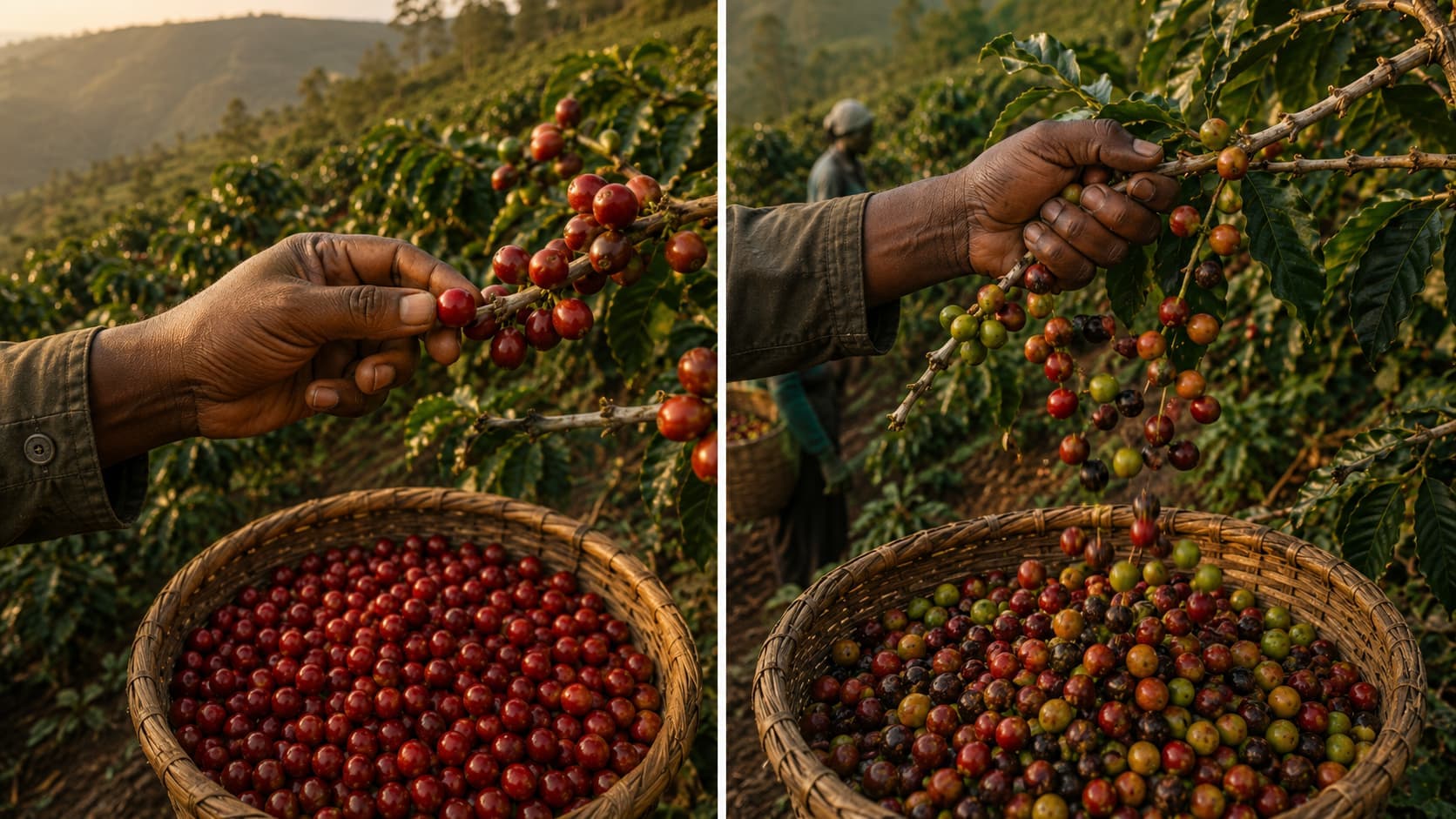
Direct Answer: Selective hand picking takes only peak-ripe cherries and leaves the rest for later passes. Strip picking removes all cherries at once regardless of ripeness. Selective picking produces higher cup quality and fewer defects. Strip picking is faster but requires intensive downstream sorting to compensate.
The choice depends on your labor model, terrain, and target market.
Selective picking is essential for specialty lots. Pickers make two to four passes per block across a harvesting window of several weeks. This keeps immature and overripe fruit off the picking baskets. The trade-off is cost: in steep, non-mechanized regions, selective picking can account for up to 40 percent of total production costs (TechnoServe, 2022).
Strip picking cuts picker time dramatically. All cherries come off the branch in a single pass. But unripe cherries, overripe cherries, and dried “raisin” fruit all land in the same bag. Without solid flotation and density sorting downstream, this will contaminate your specialty lots with Category 1 defects.
Semi-mechanical devices offer a middle path in some origins. Research by the Colombian National Coffee Research Center (Cenicafé) showed that their vibrating-blade “Alfa” device increased picker yield by nearly 70 percent compared to traditional hand picking. But immature cherry detachment rates ranged from 4.5 to 10.3 percent, so downstream sorting stays non-negotiable.
⚠️ Common Mistake: Paying pickers purely by weight with no quality incentive encourages harvesters to strip branches and toss in ground-fallen fruit to inflate their bag weight. That single management failure introduces ochratoxin-producing fungi and Coffee Berry Borer contamination directly into your primary lot (ICO, 1988).
💡 Pro Tip: Use a split payment structure. Pay a base rate per kilogram delivered and add a quality bonus when bag spot-checks confirm less than five percent immature or overripe cherries. Transparent, fair incentives are the fastest quality-control tool you have.
What Happens to Cherry Quality After Picking?
Direct Answer: Once picked, coffee cherries start to degrade fast. Cellular respiration consumes sugars, the mucilage layer begins to break down, and uncontrolled fermentation starts within 12 to 24 hours at tropical temperatures. Fast processing isn’t optional. It’s a quality control requirement.
The chemistry of delay works against you in three ways.
First, respiration loss. Picked cherries keep burning sugars and losing moisture. Research shows that processing cherries within 24 to 36 hours of picking can preserve up to six percent of clean green bean weight compared to delayed setups (Sweet Marias, 2020). That’s six percent less coffee to sell.
Second, mucilage decomposition. The pectin-rich mucilage normally helps cherries slide cleanly through pulper drum grooves. After 24 hours, this layer starts to break down. Degraded mucilage causes beans to stick, which leads to nicking, scratching, and chipping during pulping. Damaged seeds are highly vulnerable to fungal infection during drying.
Third, uncontrolled fermentation. Warm, compacted cherry bags create anaerobic conditions fast. Wild yeasts and bacteria generate acetic acid, which penetrates the endocarp and creates sour beans with harsh, vinegary, and medicinal off-flavors. No amount of drying or sorting can reverse that.
📊 By the Numbers: Some regional quality standards, including Rwandan Minimum Quality Guidelines, require cherry delivery and processing within eight hours of picking (TechnoServe, 2024). Even in cooler highland conditions, a hard 24-hour limit should be your maximum.
✅ Best Practice: Use shade and ventilation between the field and the wet mill. Keep cherry bags out of direct sun. Don’t stack or over-compress bags. Thin, breathable mesh crates are far better than sealed polypropylene sacks.
How Does Flotation Sorting Work at Wet Mill Reception?
Direct Answer: Flotation sorting separates cherry lots by density when they enter water-filled channels or siphon tanks. Dense, mature cherries (sinkers) drop to the bottom and go to primary pulpers. Low-density cherries (floaters) including immature, insect-damaged, and dried raisin fruit rise to the surface and get skimmed off and processed separately.
Flotation is the most cost-effective first-pass quality gate you have at the wet mill.
A proper reception protocol runs in four steps. Log the delivery time, lot ID, farm block, and variety before anything else. Measure the incoming Brix with a calibrated refractometer to confirm the lot meets your minimum ripeness standard. Direct the cherries into the flotation channel. Start pulping within eight to 24 hours of harvest (TechnoServe, 2024).
Floaters must be kept separate and processed as a lower-grade lot. Mixing floaters back into your specialty batch after sorting defeats the purpose entirely. Process and store them separately, label them clearly, and price them accordingly.
🔍 Definition: A “sinker” is a mature, high-density cherry that sinks in water, indicating a fully developed seed with good sugar content. A “floater” is a low-density cherry that rises, usually because the seed inside is hollow, insect-damaged, or not fully developed.
How Does Lot Traceability Protect Your Market Access?
Direct Answer: Lot traceability links every batch of harvested coffee to a specific farm block, picking date, harvesting team, and quality measurement. Without this chain of custody, you can’t prove where your coffee came from, satisfy specialty buyer requirements, or comply with emerging regulations like the EU Deforestation Regulation (EUDR).
The EUDR, which applies to all coffee entering the European Union, requires producers to prove their coffee didn’t come from land deforested after December 31, 2020. That means GPS-mapped farm plots, documented lot identities, and digital chain-of-custody records retained for a minimum of five years. Any mixing of compliant and non-compliant lots can result in an entire shipment being rejected at customs.
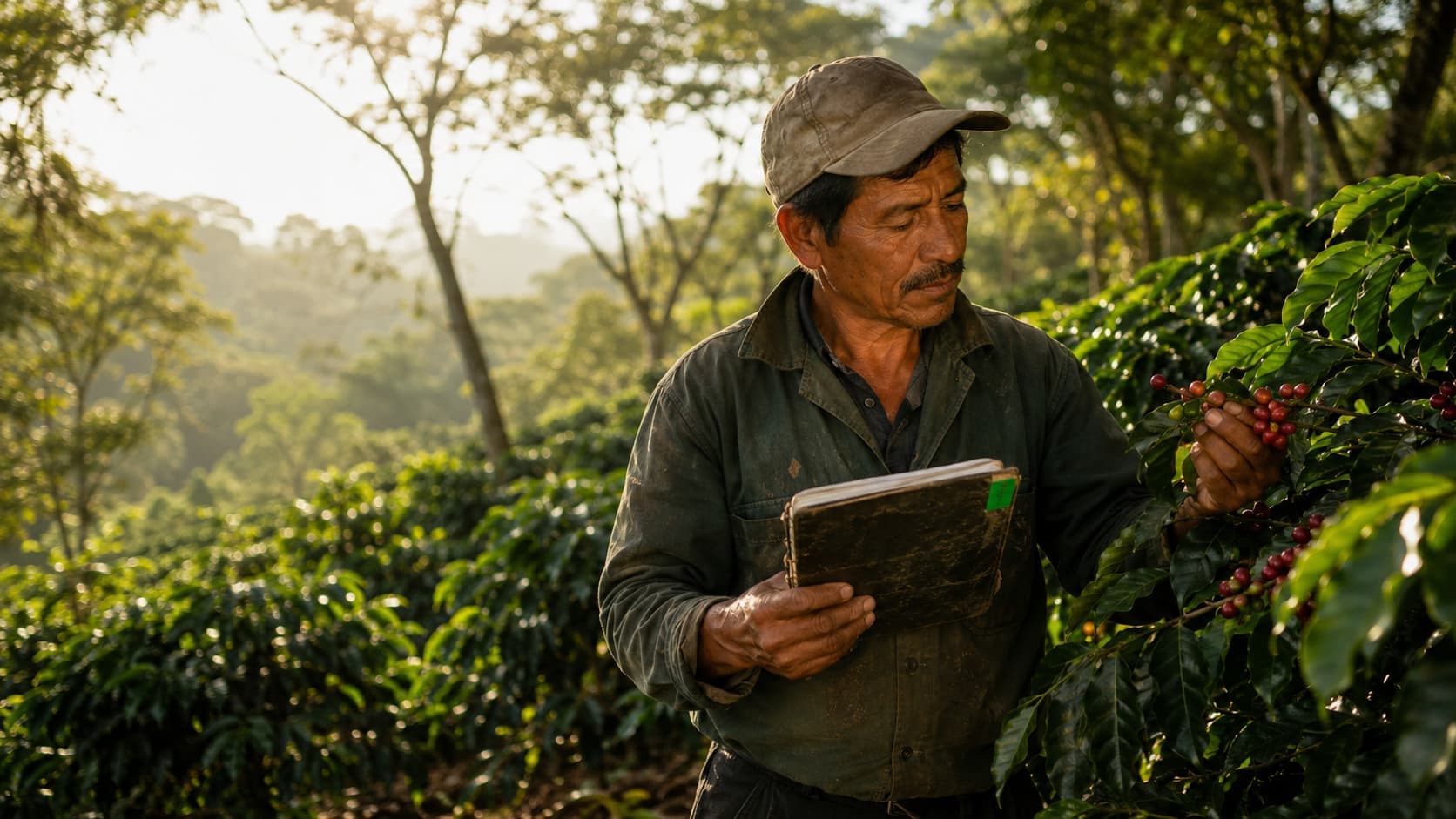
This is where operational data from the harvest day becomes a business asset, not just a paperwork requirement. Each cherry delivery should be logged with block ID, GPS polygon reference, variety, picking team, delivery weight, Brix measurement, and quality audit result. That record is your lot story. Specialty buyers pay for stories they can verify.
Tracking this data manually across a busy harvest season is where most farms lose control. Notebooks disappear. Handwriting is illegible. Lot identities get mixed up during peak processing days. FarmSentry’s activity logging system lets harvest supervisors record each delivery by block, picker team, weight, date, and quality notes in real time, so every lot entry is timestamped and searchable from day one of harvest through export.
💡 Pro Tip: Assign a unique lot code to every cherry delivery at reception, before it enters the flotation tank. Once cherries are mixed, their individual origin identity is gone forever.
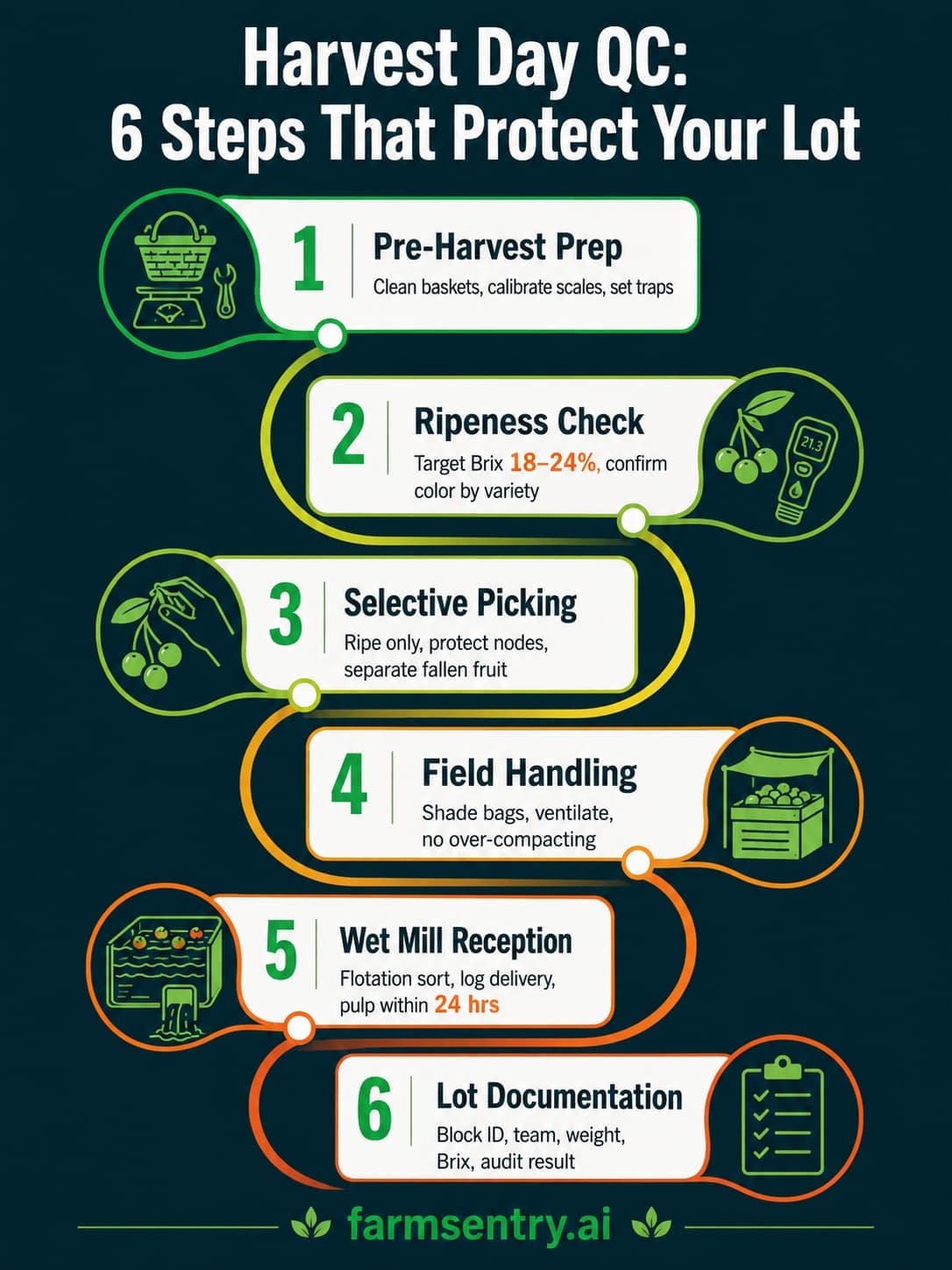
<infographic>
What Are the Key Defects That Destroy Cup Quality?
Direct Answer: The six defects most likely to destroy a specialty lot are: full black beans, full sour beans, fungal damage, severe insect damage (Coffee Berry Borer), immature/quaker beans, and broken or chipped seeds. A single Category 1 defect in a 350-gram sample instantly disqualifies a lot from specialty grade.
The Specialty Coffee Association (SCA) grading standard is unforgiving. A 350-gram green coffee sample must have zero Category 1 (primary) defects and no more than five Category 2 (secondary) defects to qualify as specialty grade. One full black bean, full sour bean, or moldy bean drops the entire lot to commercial commodity pricing.
📊 By the Numbers: Analytical testing estimates that five to 20 percent of commercial lots labeled “100% Arabica” are adulterated with Robusta beans (SGS, 2021). Adulteration may also include non-coffee fillers such as roasted corn, barley, soybeans, and chicory to inflate bulk weight. DNA fragment analysis and chromatographic profiling are the industry-standard verification methods for export shipments.
Most defects are preventable. Here’s a fast-reference guide:
Full Black Bean: Caused by severe overripening or cherries fermenting on the ground. Prevent by excluding ground-fallen fruit and shortening your harvest intervals.
Full Sour Bean: Caused by over-fermentation. Prevent by pulping within eight to 24 hours of harvest and cleaning wet-mill tanks daily.
Fungal Damage: Caused by slow or uneven drying and rain re-wetting. Prevent by covering drying tables at night and during rain, and raking beds frequently.
Severe Insect Damage (CBB): Caused by Coffee Berry Borer infestation. Prevent with field traps, systematic pruning, and removal of dried cherries from branches.
Immature / Quaker Bean: Caused by harvesting underripe cherries. Prevent by training pickers in selective harvesting and using density sorting at the wet mill.
Ground-fallen cherries are a particular risk. Soil-dwelling fungi including Aspergillus and Penicillium species produce ochratoxin A (OTA), a mycotoxin that survives roasting. Fallen cherries also serve as the primary breeding ground for Coffee Berry Borer populations (ICO, 1988). Always collect fallen cherries in separate bags and never mix them into a primary lot.
When you track defect rates by picker team and by block using FarmSentry’s reporting tools, patterns become visible within a single harvest week. If one block is consistently producing high immature percentages, you know exactly where to direct supervision and whether an additional ripening pass is needed.
Conclusion and Action Plan
The decisions made in the field during peak harvest season determine whether your coffee reaches specialty buyers or gets sold at commodity prices. No wet mill intervention, no re-sorting protocol, and no processing technique can fix a cherry that was picked too early, left too long in a hot bag, or mixed with ground-fallen fruit.
Key Takeaways:
Peak ripeness matters more than picking speed. Target 18 to 24 percent Brix and use color as a guide, not a guarantee.
The 24-hour rule isn’t flexible. Process cherries within 24 hours of harvest, or within eight hours in warm climates, to prevent irreversible fermentation defects.
Traceability starts at the tree, not at the wet mill. Every delivery needs a block ID, a team record, a weight, and a quality note before cherries hit the flotation tank.
Your Next Steps This Harvest Season:
Calibrate your refractometers now and train every field supervisor on the two-step ripeness check before picking begins.
Review your picker payment structure. If you’re paying purely by weight, add a quality-based bonus tied to spot-check results.
Set up a simple cherry reception log that captures block ID, delivery time, Brix result, and flotation sort outcome for every intake.
Audit your cherry handling chain from field to mill for any points where bags are over-compacted, left in direct sun, or delayed past the 24-hour window.
Map your farm blocks to GPS coordinates so every lot can be traced to its origin for specialty buyer requirements and EUDR documentation.
For teams moving from paper intake logs to a digital system, FarmSentry’s activity logging provides a structured way to capture picker team data, block references, delivered weights, and quality notes in a timestamped, searchable format. That harvest-day data becomes the lot story your buyers ask for at the contract table.
Social Sharing Hook: “The most expensive decision on a coffee farm takes two seconds: a picker’s hand on a cherry. Build the systems that make two seconds count.”
Free Download: Harvest Day QC Checklist and Picker Logbook Template
Stop losing harvest data to notebooks and spreadsheets. This free template gives your supervisors a field-ready daily QC checklist and a structured picker logbook with columns for block ID, team name, delivered weight, Brix readings, and defect spot-check results.
Download the template and start building lot documentation that buyers and certifiers will accept.
[Download the Harvest Day QC Checklist and Picker Logbook Template]
References
ICO. (1988). Coffee: Pest and disease management. International Coffee Organization. Available at: https://www.ico.org/documents/ed1988e.pdf [Accessed: 15 July 2025].