The Year on a Coffee Farm: An Agronomy Playbook for Commercial Operators | FarmSentry Blog | FarmSentry
Written by Claud Fields
May 15, 2026May 15, 2026
16 min read
Coffee
The Year on a Coffee Farm: An Agronomy Playbook for Commercial Operators
In short
A solid coffee farm management calendar connects pruning, fertilization, IPM, and harvest to what your trees are actually doing biologically. This playbook gives commercial operators a block-level SOP to replace memory-based management with something you can actually follow, audit, and hand to a fie
Introduction: Why Your Calendar Is Your Most Valuable Agronomic Tool
Arabica coffee is one of the most time-sensitive crops on earth. Miss the fertilizer window by three weeks, and you’re chasing a potassium deficit right when the fruit needs it most. Delay a fungicide application by one rain event, and Coffee Leaf Rust spores have already landed on a thousand leaves. Forget to schedule stumping blocks on rotation, and your oldest trees quietly drag down your whole-farm average yield.
Most commercial farms don’t fail because of bad genetics or poor soils. They fail because management decisions live in someone’s head instead of a documented, repeatable system.
A structured coffee farm management calendar fixes that. It turns the biological clock of the coffee tree into a written SOP that your field teams, agronomists, and cooperative officers can follow, audit, and improve season after season.
This playbook walks you through every phase of the coffee year: nursery and planting, soil and nutrition management, pruning and renovation, integrated pest and disease management, harvest logistics, and post-harvest compliance. All timings are framed as adaptive windows rather than fixed dates, because the right calendar for a Kenyan estate at 1,800 meters above sea level is not the same as the right calendar for a Colombian finca in Huila.
Read this as your starting SOP. Then localize it to your blocks, your altitude, and your variety.
What Is a Coffee Farm Management Calendar, and Why Does It Matter?
A coffee farm management calendar is a documented, month-by-month schedule of agronomic activities tied to the phenological stages of the coffee tree and the rainfall pattern of a specific origin. It covers planting, pruning, fertilization, pest and disease control, irrigation, harvest, and post-harvest operations.
Without a calendar, management is reactive. With one, it becomes anticipatory.
Labor typically represents 50 to 70% of total Arabica production costs (Global Coffee Platform, 2024). That figure makes timing everything. A labor peak during the wrong phase means you’re paying for work that delivers half the agronomic value. A well-built calendar aligns your biggest costs with your highest-return windows.
🎯 Key Takeaway: The coffee farm management calendar isn’t a planning luxury. It’s the core operational document that converts biological knowledge into field action.
The Building Blocks of a Good Calendar
A practical calendar operates at three levels simultaneously:
Farm level: Whole-property rhythm, covering major seasonal inputs and pest pressure windows.
Block level: Specific activities tied to the variety, age, and recent production history of each block.
Activity level: Task-by-task SOPs for each operation, including rates, timing triggers, and responsible staff.
Blocks with different varieties age differently, respond differently to pruning, and carry different pest profiles. A farm-wide calendar that ignores block variation will consistently under-serve some blocks and over-treat others. Start by mapping your blocks: variety, year of planting, and current pruning cycle stage.
How Do You Build a Block-Level Coffee Farming Calendar for Your Origin?
Building a block-level coffee farming calendar requires four inputs: your local rainfall calendar, the phenological stages of your dominant variety, your current inventory of inputs and equipment, and your block map.
Step 1: Anchor to rainfall, not the Gregorian calendar. Coffee management is driven by the transition between wet and dry seasons. In Kenya, the long rains run from March to May. In Colombia, rainfall distribution depends on altitude and department. Define your own wet season onset, dry season, and short rains before you assign any dates to anything.
Step 2: Map the phenological triggers. Arabica follows a predictable pattern after a dry-season induction period: floral bud break, flowering, fruit set, expansion, and cherry ripening. Each stage has a nutrition, pest, and labor requirement that must be pre-positioned.
Step 3: Assign blocks to pruning cycles. Cenicafé and KALRO both recommend stumping 20 to 25% of the farm annually to maintain a rolling cycle of productive, young wood (Cenicafé, 2025). Map which blocks are due for stumping, which are in their high-bearing years, and which are in early establishment. Your calendar will look different for each group.
Step 4: Assign responsible staff and input quantities by block. A calendar without a named person and a confirmed input quantity is a wish list, not an SOP.
✅ Best Practice: Review your block-level calendar at the end of each season. Log what happened, what shifted, and why. Over three to five seasons, your calendar becomes a highly localized predictive tool.
What Should Your Annual Pruning and Canopy Management Schedule Look Like?
Pruning is the single most powerful cultural practice for managing yield consistency, bean size, and pest pressure on a commercial Arabica farm. It should be the first activity anchored in your calendar each year, scheduled during the main dry season when labor is available and the trees are in relative dormancy.
Coffee bears fruit only on wood that is one year old. As trees age, productive wood migrates upward and outward, making harvesting inefficient and reducing light penetration into the canopy (FAO, 2024). A systematic pruning calendar corrects this before it becomes a yield problem.
Key Pruning Activities by Phase
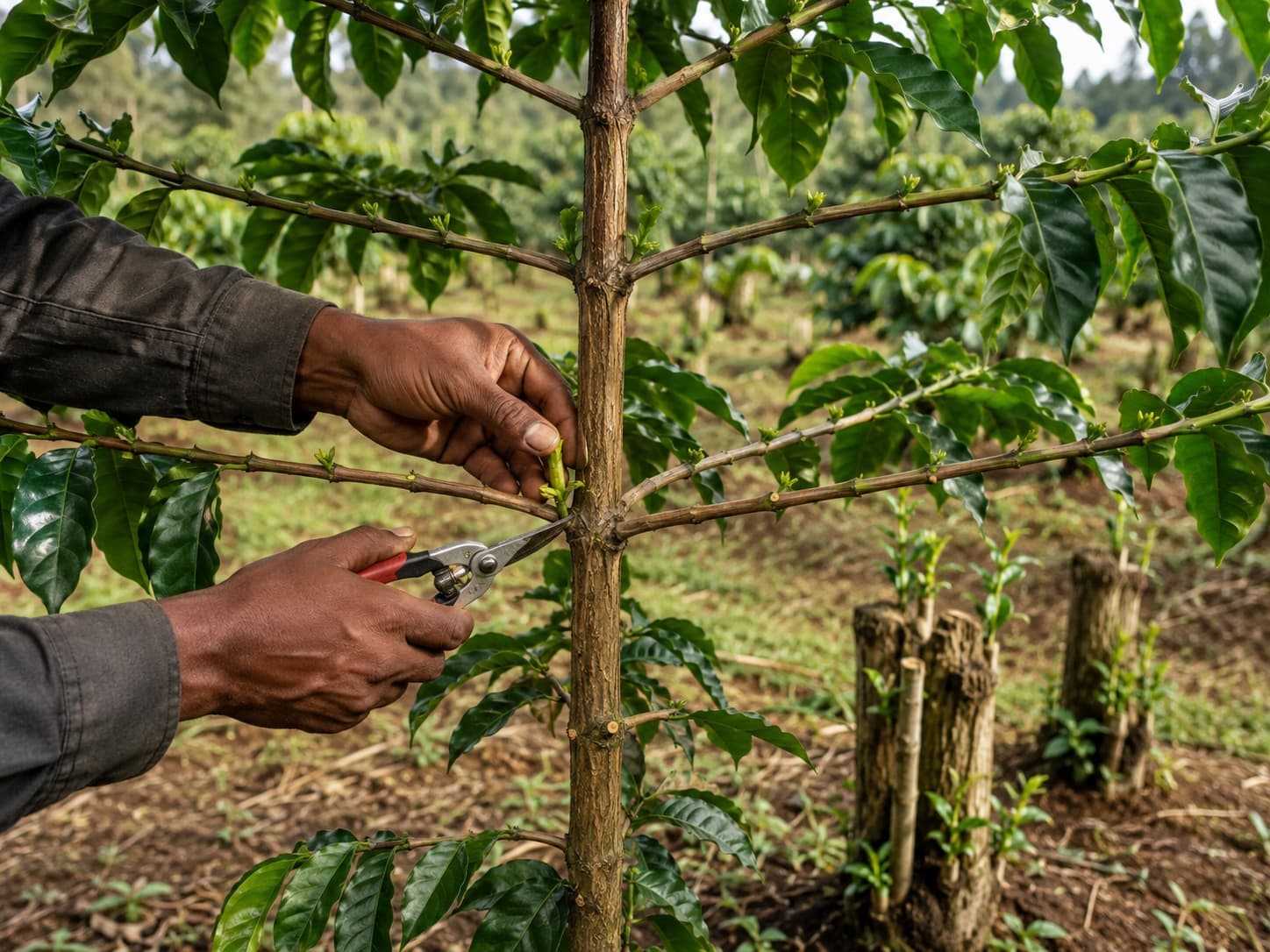
Calendar PhaseActivityObjectiveMain dry seasonStumping of 20-25% of the farmRenovate old, unproductive woodPost-stumpingSucker selection (keep 2-3 healthy stems per stump)Establish new bearing framePre-floweringHandling, desuckering, and lateral thinningOpen canopy; improve airflowPost-harvestLight pruning and removal of dead woodReduce harbor for pests and fungal spores
For single-stem systems common in intensive Colombian production, topping restricts vertical height while encouraging lateral branch development. The tree is then “handled” to create a fish-bone branch pattern that maximizes light interception and simplifies harvesting.
For multi-stem systems, as used with heritage Kenyan varieties like SL28 and SL34, the renovation cycle requires that no more than one-third of the stem population is stumped in any season. This preserves income continuity.
⚠️ Common Mistake: Stumping too many blocks in a single year creates a revenue gap two to three seasons later, right when those blocks would have been peak-bearing. Spread renovation across a five-year rolling cycle.
💡 Pro Tip: When stumping, retain one older “breather branch” per stump to maintain sap flow while the new suckers establish. Remove it once the selected suckers are fully vigorous.
How Do You Time Fertilizer Applications Across the Year?
Fertilizer timing on a commercial Arabica farm must follow both the nutritional demand curve of the tree and the rainfall calendar. Apply nitrogen during a dry spell, and most of it volatilizes as ammonia gas before the roots can absorb it. Apply it during heavy rains, and nitrates leach away below the root zone. Both scenarios burn money and produce no yield response.
Research published in Frontiers (2025) confirms that urea-based fertilization loses significant nitrogen to volatilization during El Niño dry phases and to leaching during La Niña high-rainfall events. The recommendation is to use ammonium-nitrate blends applied in three to four split doses across active growing periods to optimize nitrogen use efficiency.
A Practical Nutrient Calendar Framework
Growth StageKey NutrientsTiming TriggerApplication MethodPre-planting (basal)Phosphorus, lime, organic manure3 months before rains onsetIn-hole mixVegetative flushNitrogen (first split)Onset of long rainsSide-dressingFloweringBoron, Zinc (foliar)6-8 weeks before expected floweringFoliar sprayFruit expansionNitrogen (second/third split), PotassiumActive fruit development phaseSide-dressingCherry ripeningPotassium (final top-dress)90-120 days before harvestSide-dressingPost-harvestLime if pH below 5.3After harvest, 2-3 months before next planting inputSurface broadcast
📊 By the Numbers: Potassium demand peaks during the final 90 to 120 days of cherry development. A deficit during this phase results in light, floaty beans with a low out-turn ratio and reduced cup body (FAO, 2024).
🔍 Definition: Out-turn ratio is the weight of exportable green beans produced per unit of fresh cherry harvested. It’s a direct efficiency measure of genetics and nutrition management.
Boron is particularly important during the pre-flowering window. A boron deficiency during this period causes “star flowering,” where blossoms open but fail to set fruit (FAO, 2024). Foliar boron and zinc sprays two months before expected flowering are a low-cost intervention with a direct impact on fruit set and uniformity.
Soil pH must be maintained between 5.5 and 6.0. When pH drops below 5.3, aluminum toxicity blocks phosphorus uptake and weakens root systems. Apply agricultural lime or dolomite two to three months before the main fertilizer cycle to allow time for soil reaction.
What Is the Best Approach to IPM on a Commercial Coffee Farm?
Integrated Pest Management (IPM) on a commercial Arabica farm combines genetic resistance, cultural sanitation, biological controls, and targeted chemical applications. The goal is to reduce pest and disease pressure before it reaches economic thresholds. Not to react to visible damage after it has already cost you yield and quality.
The Major Threats and How to Manage Them
Coffee Leaf Rust (CLR, Hemileia vastatrix): CLR devastated Colombian production between 2008 and 2011, reducing national yields by 31% (Cenicafé, 2025). The primary response in Colombia was rapid adoption of rust-resistant varieties including Castillo and Cenicafé 1. For estates still growing susceptible varieties, a fungicide calendar must begin before the rains with protective copper-based sprays, followed by systemic triazoles during active infection periods.
Coffee Berry Disease (CBD, Colletotrichum kahawae): CBD is the primary yield-limiting pathogen in high-altitude Kenyan coffee. It attacks green berries during the expansion phase and turns them into mummified, unsaleable husks. Resistant varieties like Batian and Ruiru 11 reduce pesticide costs by approximately 30% (KALRO, 2019). For susceptible SL28 and SL34 blocks, fungicide applications must begin at the onset of rains and continue every three to four weeks through berry development.
Coffee Berry Borer (CBB, Hypothenemus hampei): The CBB is the world’s most economically damaging coffee insect pest (PMC, 2016). It completes its entire life cycle inside the cherry, which protects it from most surface-applied pesticides. The most effective management is the “Re-Re” (Recollection and Removal) method: a post-harvest sanitary harvest that removes all leftover cherries from trees and the ground, breaking the reproductive cycle before the next season.
Antestia Bug (Antestiopsis spp.): In Kenya, Rwanda, and Burundi, the Antestia bug introduces bacteria into berries that produce a raw potato aroma in the brewed cup. A single “potato bean” can contaminate an entire bag, disqualifying a lot from specialty markets. Canopy management is the first line of defense: open pruning reduces the dense, dark foliage the bug prefers. Scout for more than two bugs per tree before applying pyrethrum-based sprays.
IPM Calendar Summary Table
Pest or DiseaseKey SymptomThreshold for ActionPrimary ControlSecondary ControlCoffee Leaf RustOrange powder on leaf undersideAny visible infection on susceptible varietiesResistant variety (Castillo, Batian)Copper fungicide (protective); Triazole (curative)Coffee Berry DiseaseSunken dark lesions on green berriesOnset of rains on susceptible blocksResistant variety (Ruiru 11, Batian)3-4 week fungicide cycle during berry developmentCoffee Berry BorerSmall hole at blossom end of cherryGreater than 2% infestation; 50%+ in entry positionSanitary “Re-Re” harvestBeauveria bassiana biological sprayAntestia BugBerry drop; potato aroma in processed cupMore than 2 bugs per treeOpen-canopy pruningPyrethrum or alpha-cypermethrin sprayRoot-Knot NematodeYellowing; stunted growth; root knottingConfirmed at soil samplingCertified disease-free seedlings; organic matterNematode-resistant rootstock grafting
✅ Best Practice: Log every scouting observation by block and date. Patterns in pest pressure across seasons reveal which blocks need variety transition, canopy adjustment, or shade modification.
How Do You Track Yield and Conversion Data to Improve Season After Season?
Yield data without conversion data tells you how much cherry you picked. Conversion data tells you how much of that cherry was actually worth picking.
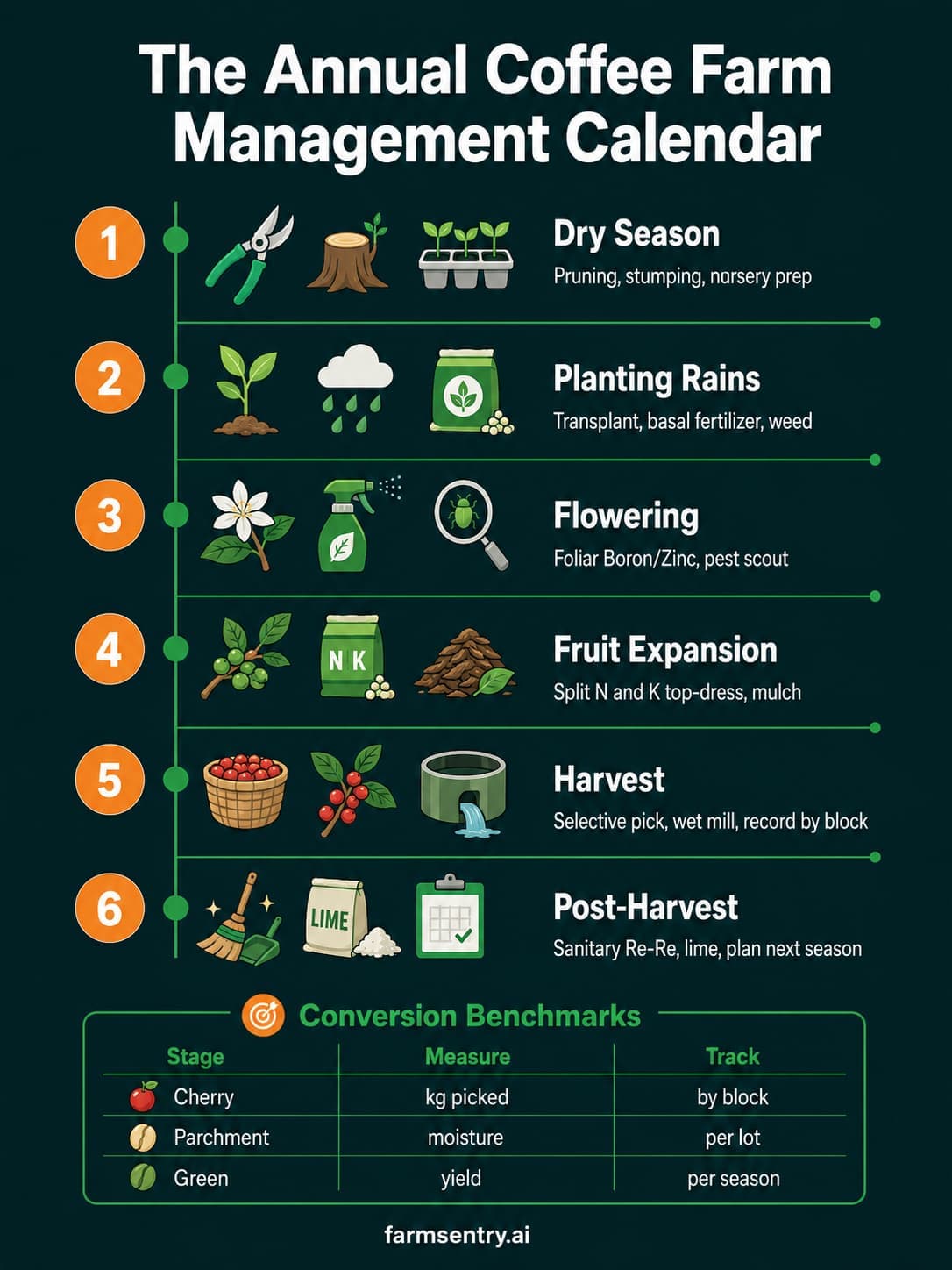
📊 By the Numbers: It takes approximately 5 to 6 kilograms of fresh cherry to produce 1 kilogram of exportable green coffee. Industry benchmarks show that 100 kilograms of fresh cherry yields around 20 kilograms of dry parchment and approximately 16 kilograms of clean green beans.
Processing StageConversion FactorOutput from 100 kg Fresh CherryFresh cherry to dry parchment0.2020 kg dry parchment at 11-12% moistureDry parchment to green bean0.8016 kg clean green beansFresh cherry to green export bean0.16 to 0.1816 to 18 kg total
High-density varieties like Castillo are bred for a lower cherry-to-bag conversion ratio, meaning farmers harvest less volume for the same exportable weight. Tracking conversion efficiency by block and by variety reveals which blocks are delivering value and which are consuming labor without adequate return.
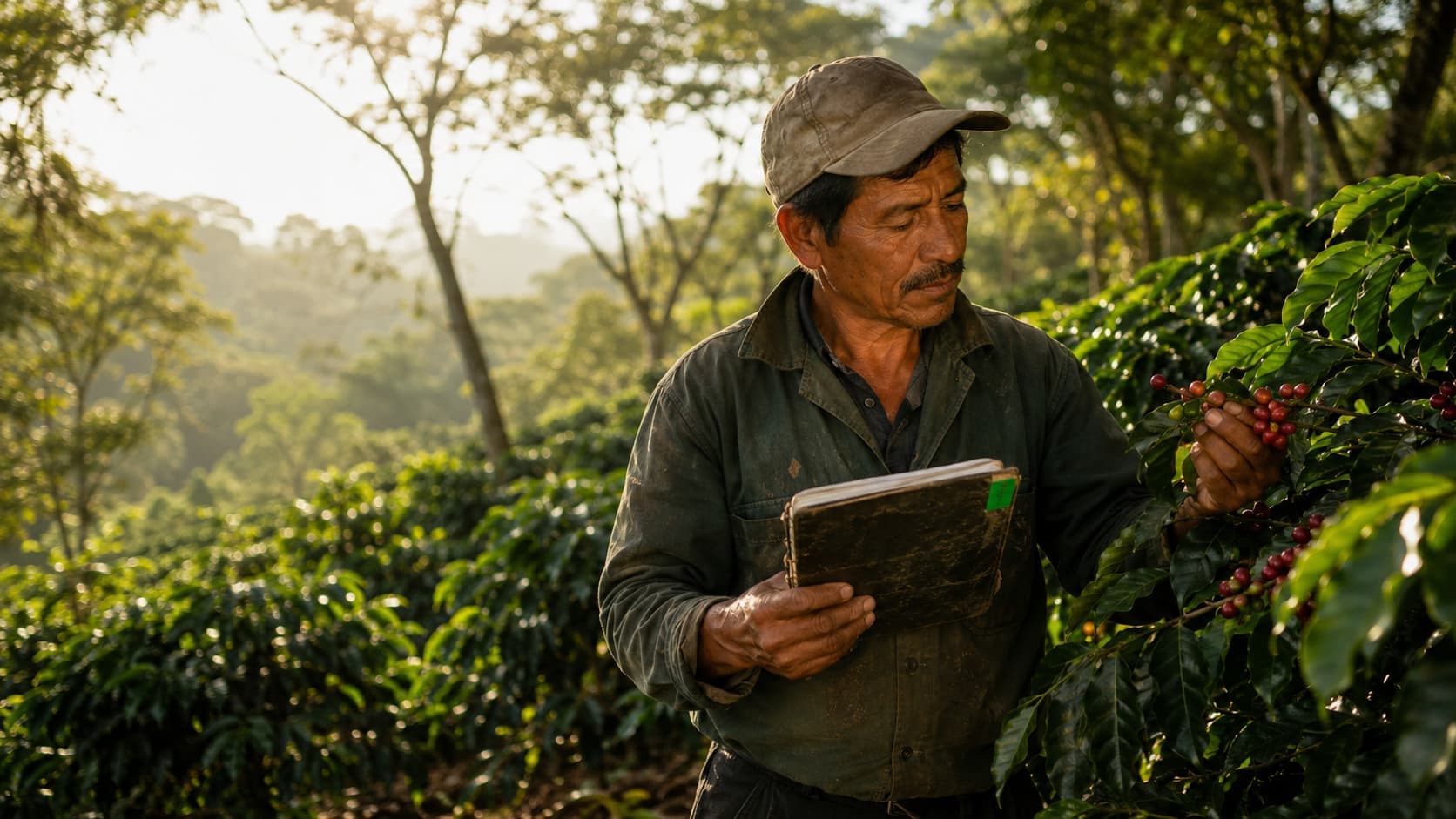
Here’s the thing: block-level recordkeeping stops being optional the moment you want to make defensible decisions. When you know the yield per tree, the conversion ratio, and the cupping score for each block, every pruning, nutrition, and variety decision in the following season is anchored in real data rather than memory. Tools like FarmSentry’s activity logging and dashboard analytics let you log inputs, scout observations, and harvest weights by block in real time, turning each season into a structured learning loop.
When Do Planting, Renovation, and Stumping Fit Into the Annual Calendar?
New planting and block renovation must be scheduled around two fixed constraints: the onset of the long rains and your nursery cycle.
Prepare planting holes three months before the rainy season to let the subsoil weather and aerate. Transplant seedlings at the onset of rains so they can establish a root system before the next dry season hits. Transplant too late in the wet season, and those seedlings face their first dry period without adequate roots to survive it.
World Coffee Research has found that a high percentage of non-certified seed lots in Latin America show significant genetic noncompliance (WCR, 2024). That means farms sourcing uncertified planting material may be investing establishment costs in trees that will never meet varietal yield or disease resistance benchmarks. Sourcing from certified nurseries with demonstrated variety integrity isn’t optional. It’s the baseline for any renovation investment worth making.
The nursery cycle itself takes six to ten months from seed to field, depending on altitude and temperature. So if you plan to renovate a block in the upcoming long rains, your nursery order needs to be placed six to ten months before transplanting. Most farms miss this window because renovation planning is an afterthought, not a calendar item.
How Does Regulatory Compliance Fit Into Your Farm Calendar?
International market access is increasingly tied to documented farm management, not just cup quality. Two major regulatory shifts affect commercial Arabica operators selling into EU markets from 2024 onward.
The EU Deforestation Regulation (EUDR) requires all coffee imported into the EU after 2024 to be geolocated and proven to originate from land not deforested after 2020 (Efico, 2025). Every lot must carry spatial data linking the coffee to a specific, verified parcel.
The EU’s updated organic certification regulation, effective October 2025, ends the “equivalency” system that previously allowed non-EU producers to meet a lighter standard. All certified organic coffee must now comply with the same soil and input requirements as EU domestic producers (Efico, 2025).
On the chemistry side, Maximum Residue Limits (MRLs) for neonicotinoids including clothianidin and thiamethoxam are being reduced to the limit of determination (0.01 mg/kg) by 2026 for EU markets. Any farm still using these chemistries on coffee needs to start transitioning spray programs now to avoid rejection at market entry.
Let’s be honest: compliance isn’t a document you generate at the end of the season. It’s a record you build throughout the season, lot by lot and block by block. Every spray, every harvest date, every fermentation time, and every input application needs to be logged at the time it happens.
FarmSentry’s activity logging module is built for exactly this kind of systematic, real-time recordkeeping. When your buyer requests proof of your spray program or your harvesting dates, you export a complete, block-level log rather than trying to reconstruct events from memory months after the fact.
Turn This Playbook Into Your Farm’s Operating System
A coffee farm management calendar is only as valuable as the discipline used to follow and update it. The farms that consistently outperform their peers in yield, quality, and buyer relationships aren’t necessarily the ones with the best soils or the most favorable altitude. They’re the ones that treat each season as a documented learning cycle.
Key Takeaways
Anchor your calendar to your local rainfall pattern, not the Gregorian calendar. Every agronomic window is triggered by a climate event, not a date.
The most expensive mistakes in coffee production happen in the pre-flowering and fruit expansion phases, when interventions are cheap but the consequences of inaction are enormous.
Block-level recordkeeping is no longer optional. EUDR traceability requirements and MRL compliance demand documented, lot-specific farm histories.
Your Implementation Roadmap
This week: Map your blocks by variety, planting year, and current pruning stage.
This month: Confirm your local wet and dry season transition dates with your local extension office or cooperative agronomist.
Before the next dry season begins: Schedule your pruning and stumping blocks, place your certified nursery order for any planned renovation, and confirm your lime inventory.
At season start: Begin logging all inputs, spray events, and scouting observations by block and date. Don’t reconstruct records at the end of the season.
At harvest: Record cherry weight, harvest date, and picker batch quality by block. Calculate your conversion ratio at the mill.
A financial management system that ties input costs to individual blocks and tracks your cost-per-kilogram against your block yield gives you the real number: which blocks are profitable, which are candidates for variety change, and where your next season’s investment should go.
“A coffee farm management calendar doesn’t predict the weather. It ensures that when the weather cooperates, you’re already positioned to capture it.”
PMC. (2016). Integrated pest management of coffee berry borer: Strategies from Latin America that could be useful for coffee farmers in Hawaii. PubMed Central. https://pmc.ncbi.nlm.nih.gov/articles/PMC4808786/