The 3-Year Shift: Your Practical Guide to Transitioning to Organic Coffee Certification | FarmSentry Blog | FarmSentry
Written by Claud Fields
June 9, 2026Jun 9, 2026
13 min read
Coffee
The 3-Year Shift: Your Practical Guide to Transitioning to Organic Coffee Certification
In short
Transitioning to organic coffee certification locks you into 3 mandatory years before you see a single premium dollar. Get your soil, pest management, and records right from day one, and the payoff is real.
Introduction
The global organic coffee market is already worth over USD 8 billion and is projected to hit nearly USD 20 billion by 2034 (Straits Research, 2025). That’s a real opportunity, not a marketing slogan.
But I’ve talked to plenty of conventional farmers who want in and have no idea where to start. They’re worried about losing income during the transition. They don’t know what certifiers actually want to see in their records. And they’re not sure their farm can hold together without synthetic sprays keeping the pests down.
This guide answers those questions straight. By the time you finish reading, you’ll know the 3-year timeline, the soil-building approach that keeps your plants fed, the natural pest tools that actually work, the paperwork certifiers expect, and the financial reality you need to plan around.
Let’s go through it step by step.
What Is the 3-Year Organic Transition Period?
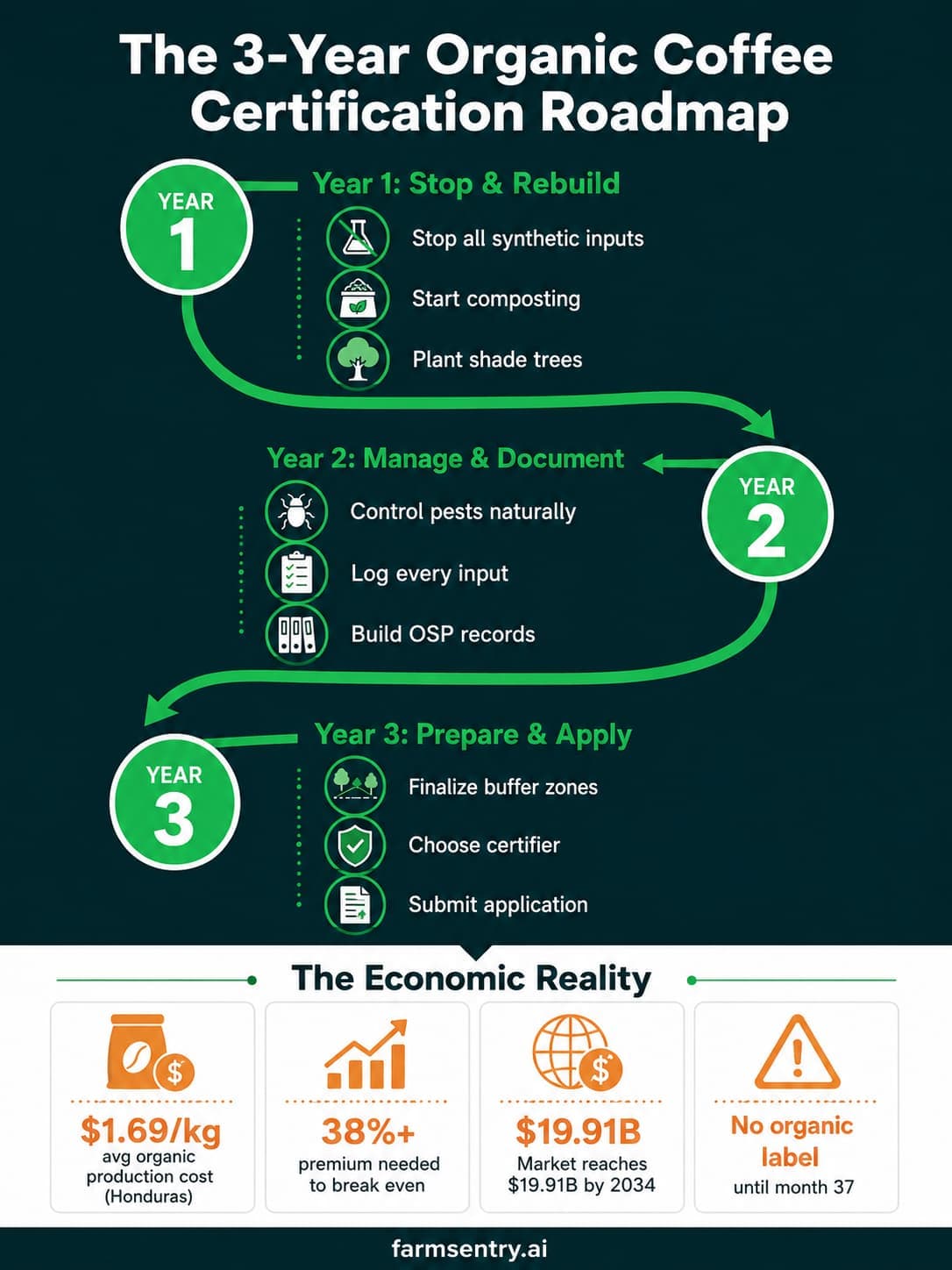
Transitioning to organic coffee certification requires a mandatory 36-month window. During that time, you must completely stop using all prohibited synthetic fertilizers, pesticides, and herbicides. You can’t sell your coffee with an organic label or earn organic price premiums until those 36 months are officially done.
This is the hardest financial stretch you’ll face. Yields may drop. Labor costs will go up. Your income stays at conventional prices the whole time. A lot of farmers call it the “valley of death” of the transition. That’s not an exaggeration.
🎯 Key Takeaway: The 3-year transition is legally required under all major certification standards, including USDA Organic and EU Organic. There are no shortcuts, and no certifier will make exceptions.
Here’s why the dip happens. In conventional farming, your coffee plants feed directly on highly soluble synthetic nitrogen, phosphorus, and potassium. Pull those inputs out and the plants go through an adjustment period. At the same time, your soil microbiome slowly wakes back up. Beneficial bacteria and fungi start cycling organic nutrients the way they’re supposed to. It takes time, but it builds a far more resilient farm in the long run (MDPI, 2021).
⚠️ Common Mistake: Thinking that stopping chemicals is enough. Just doing nothing isn’t organic farming. It’s neglect. You must actively replace every synthetic input with a biological or mechanical alternative from day one.
To protect your income during the transition, try these strategies:
Plant short-cycle cash crops between your coffee rows. Beans, maize, and bananas generate revenue while your coffee transitions.
Talk to your cooperative about transitional buyer agreements. Some importers offer a small “transition premium” to lock in future organic supply.
Cut your cash operating costs by switching to farm-produced compost before you formally begin, so you’re not buying expensive external inputs.
How Do You Build Healthy Soil Without Synthetic Fertilizers?
The goal here isn’t to feed your plants directly. It’s to feed your soil. Healthy soil microbes digest organic matter and release nutrients slowly to your coffee roots. That process builds lasting fertility instead of the short-term hit you get from chemical feeding.
You’ve got three core tools for organic soil fertility:
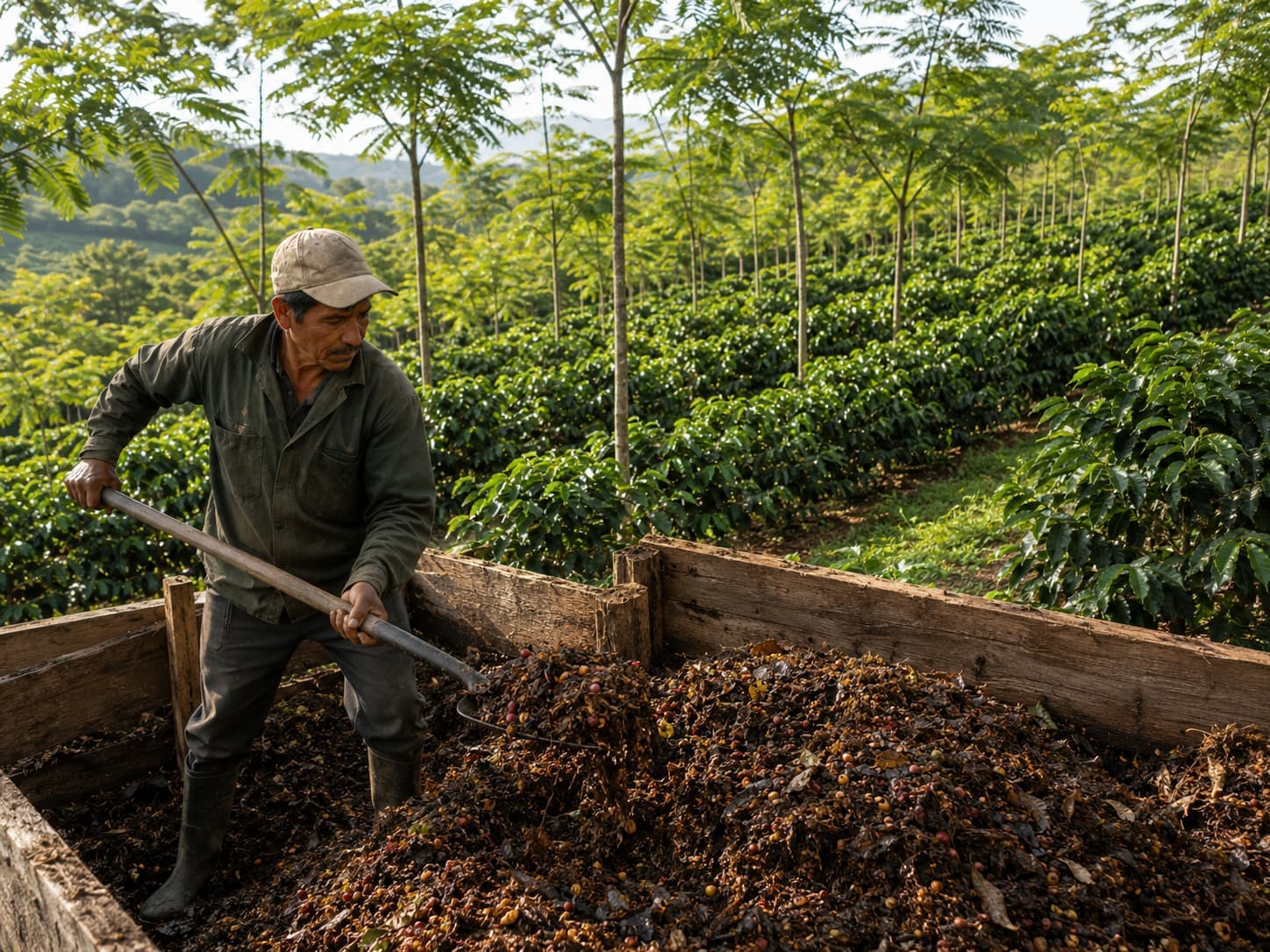
1. Coffee pulp compost. Don’t throw away your coffee pulp after processing. Compost it. Mix it with animal manure and green plant material, turn the pile regularly to aerate it, and apply it heavily to your fields multiple times per season. Research in Costa Rica shows that well-managed coffee-pulp compost rebuilds the soil’s nutrient-holding capacity and improves moisture retention during dry periods.
2. Leguminous shade trees. Plant nitrogen-fixing shade trees like Inga edulis or Erythrina species between your coffee rows. Their roots pull nitrogen from the air and fix it in the soil. Their leaf litter fertilizes the surface. A well-managed shade canopy can also drop your farm’s peak daytime temperature by more than 5 degrees Celsius, which protects your plants from heat and water stress (MDPI, 2021).
3. Microbial biofertilizers. Use mycorrhizal fungi to extend your plants’ root reach so they can access phosphorus deeper in the soil. Apply Trichoderma as a soil drench or directly into your compost piles. This beneficial fungus breaks down organic matter faster and protects roots from fungal pathogens. Field studies in Peru found that combining mycorrhizae with humic acid applications significantly improved coffee plant height, stem diameter, and total biomass compared to basic compost alone.
✅ Best Practice: Start composting your coffee pulp and building your shade canopy before your official 36-month transition begins. Soil biology takes time to establish, and you want a head start.
How Do You Control Coffee Pests Organically?
Organic pest management means keeping pest populations suppressed, not wiping out every insect on your farm. The goal is to hold pests below the level where they cause serious economic damage.
The two biggest threats you’ll face are the Coffee Berry Borer and Coffee Leaf Rust.
Coffee Berry Borer (CBB): This small beetle bores into your coffee cherry and destroys the bean from inside. Contact sprays are largely useless once the borer enters the berry. Organic farmers rely on two proven strategies.
First, hang simple traps baited with a 1:1 mixture of methylated spirit and water throughout your farm. Research conducted in Tanzania’s Kilimanjaro region found that locally made, low-cost traps performed comparably to expensive commercial traps across a full calendar year, making them a practical suppression tool for smallholder farmers (Science Publishing Group, 2026).
Second, apply Beauveria bassiana, a naturally occurring fungus that kills borers without harming bees. Spray it right after harvest, before the new fruiting cycle starts, when pest populations are at their lowest.
Coffee Leaf Rust (CLR): This fungal disease spreads fast in humid, over-shaded conditions. Your primary defense is managing your canopy. Keep shade cover between 30 and 50 percent. That level of cover ensures enough airflow and sunlight to dry your coffee leaves quickly after rain, which dramatically slows rust spread.
💡 Pro Tip: Prune your shade trees and coffee plants at the same time, once per season. You’ll hit your target canopy density and airflow in a single labor pass.
For farmers in East Africa: If you grow Arabica in Rwanda or Tanzania, watch for the Antestia bug. It feeds on green cherries and spreads fungal disease. Use pyrethrum extract sprays when populations exceed one bug per tree in wetter zones. Neem oil applied to foliage also acts as a strong deterrent and reproductive inhibitor.
What Records and Documents Do You Need for Organic Certification?
Every organic practice you carry out must be written down. If it’s not documented, it didn’t happen as far as your certifier is concerned.
Your records must capture:
Every compost application: date, quantity, and exact field location
Every pest or disease spray: product name, application rate, and reason for use
All seed and input purchases, including receipts
Harvest weights by field or lot
Storage and transport details showing that organic coffee was never mixed with conventional lots
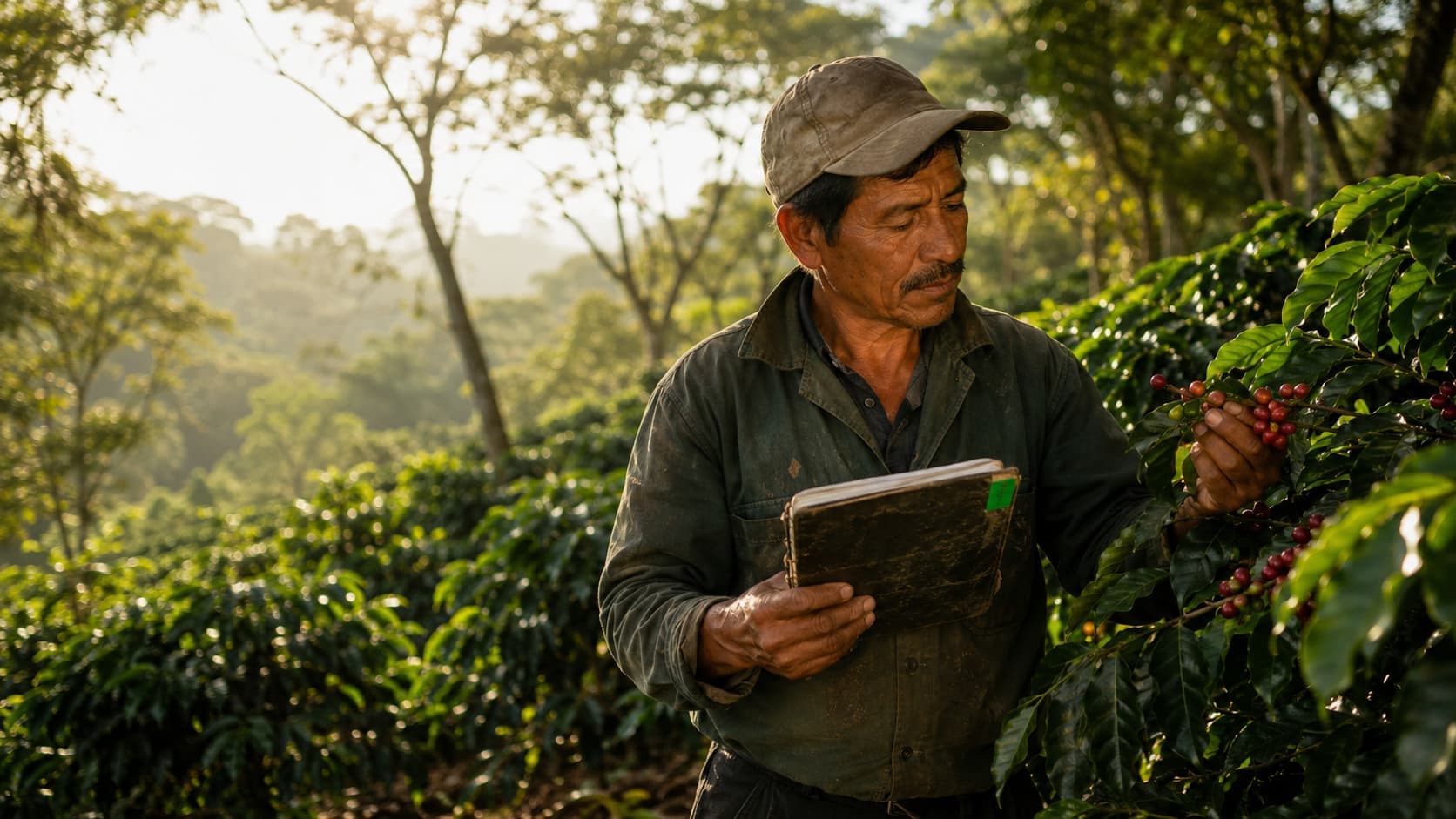
These records form your Organic System Plan (OSP). It’s the central document of your certification application and the primary evidence your auditor will review (USDA, 2024).
You also need physical buffer zones. A 50-foot boundary between your certified organic fields and any neighboring conventional farm is the accepted standard. Coffee trees inside that zone can’t be sold as certified organic (USDA, 2024).
Keeping all of this straight by hand is possible, but it’s hard to sustain over three or more years. Many farmers use digital tools to stay accurate and audit-ready. FarmSentry’s activity logging lets you record every farm task with dates, quantities, field locations, and notes, so your treatment logs and input records are always complete when inspection time comes.
📊 By the Numbers: Certified organic coffee costs an average of $1.69 per kilogram to produce in Honduras, compared to $1.13 per kilogram for conventional coffee. Labor accounts for 69 percent of total organic production costs (HortTechnology, 2023). That margin means tight records and premium buyer access aren’t optional. They’re how you survive.
What Are the True Economics of Going Organic?
Let’s be honest. Going organic costs more per kilogram to produce. That’s the starting point for any serious financial plan.
Here’s what shifts when you remove synthetic inputs:
Labor costs rise sharply. Manual weeding, compost turning, trap installation, and multiple smaller fertilizer passes replace the efficiency of a single synthetic spray or soluble fertilizer application.
Input costs also increase. Compost materials, biofertilizers, and botanical sprays aren’t free, even when produced on-farm.
Yields decline during transition. Expect lower cherry production in years one through three as your soil adjusts.
No premium income during transition. All of this happens while you’re still earning conventional market prices.
Researchers estimate that organic farmers need a premium of at least 38 percent above conventional prices just to offset the higher labor, certification, and compliance costs that come with organic production.
The premium is real, but it has conditions. A study of double-certified (Fairtrade and Organic) smallholders in Ethiopia’s Sidama region found that certified farmers achieved significantly higher coffee incomes and cooperative dividends than non-certified neighbors (Berihun, 2024). But the research found that those benefits were strongly tied to how well their cooperative was run. Farmers in poorly managed cooperatives earned far less from their organic status, even with valid certification.
🔍 Definition: A cooperative’s Internal Control System (ICS) is the administrative structure that tracks which member farms are compliant, reviews individual farm records, and confirms that coffee lots exported under the cooperative’s name are genuinely organic.
Knowing your exact cost per kilogram, before and during transition, is the only way to plan with any confidence. FarmSentry’s financial management tools let you track income, labor expenses, and input costs by field so you can see exactly where you stand relative to your break-even premium threshold.
How Does the EU’s New Organic Regulation Affect Your Certification?
If you’re planning to export organic coffee to Europe, a major regulatory shift directly affects your cooperative’s eligibility and administrative requirements.
EU Regulation 2018/848 took full effect for non-EU coffee exporters on October 1, 2025. It eliminates the old “equivalence” agreements that let producing countries certify farmers under their own national standards and have that certification accepted in Europe. All farms and cooperatives must now comply directly with European rules (EFICO, 2025).
The four biggest changes for smallholder cooperatives are:
Membership cap: A single certified cooperative group cannot exceed 2,000 members. Large unions must split into smaller, separate entities.
No mixed cooperatives: A cooperative can’t include both organic and conventional farmers. All members must be certified organic, or the group certificate is invalid.
Individual audit threshold: Any farmer with more than 5 hectares of land or more than 25,000 euros in annual sales must get a separate, individually audited certification. That’s significantly more expensive than group certification.
Pre-export residue testing: Importers must secure an electronic Certificate of Inspection through the EU’s TRACES system before coffee leaves your country. Lab testing can add 1 to 2 weeks to your shipping timeline (EFICO, 2025).
⚠️ Common Mistake: Assuming your existing certification automatically qualifies for the EU market under the new rules. It likely doesn’t. Contact your certifying agent now, before your next harvest, to confirm your cooperative’s compliance status.
Generating audit-ready compliance documentation gets a lot easier when your records are already organized digitally. FarmSentry’s reports and export tools let you build accurate compliance reports that cooperatives can use to prepare for third-party inspections and to support the data required for e-COI applications.
Conclusion and Action Plan
Transitioning to organic coffee certification is one of the most demanding commitments you can make as a farmer. It’s also one of the smartest, if you go in with a plan. The market data is clear: premium buyers are actively looking for certified, traceable, organic coffee. Farmers who plan carefully, document everything, and work through well-run cooperatives are the ones who capture that value.
Key Takeaways:
The 3-year transition is non-negotiable and financially demanding. Plan your cash flow before you begin, not after.
Organic farming demands more labor, more management, and more documentation than conventional farming. It rewards farmers who treat it as a business system, not just a philosophy.
Cooperative quality matters as much as farm quality. Your premium depends on your group’s ability to aggregate volume, maintain compliance, and reach buyers who pay for certification.
Your Implementation Roadmap:
This week: Test your soil. Know your starting nutrient levels, pH, and nematode pressure before you change anything.
This month: Meet with your cooperative agronomist or a local certifying agent. Understand the specific documentation requirements for your target export market.
Before transition begins: Start composting your coffee pulp and plant your first leguminous shade trees. Both need a head start.
From day one: Set up a daily record-keeping system, digital or paper, and log every single input you apply. If it’s not written down, it won’t count.
Before your next harvest: Review your cooperative’s structure against EU 2018/848 requirements if Europe is your sales target.
Share this with your cooperative members: “Organic farming is not cheaper or easier. It is more ecological, more labor-intensive, and, with the right buyers and a strong cooperative, more profitable. The difference between success and failure is almost always in the planning.”
MDPI. (2021). Organic farming practices and shade trees reduce pest and disease incidence in coffee agroforestry systems. Life, 11(5), 413. Available at: https://www.mdpi.com/2075-1729/11/5/413 [Accessed: 9 June 2026].