How to Maximize Grain Crop Yields with Precision Farming | FarmSentry Blog | FarmSentry
Written by Claud Fields
May 2, 2026May 2, 2026
12 min read
Crops
How to Maximize Grain Crop Yields with Precision Farming
In short
Precision farming tools like variable rate technology, soil mapping, and real-time data analytics help Midwest grain farmers maximize grain crop yields and cut input waste significantly. Learn the strategies that move the needle on your operation. ---
Introduction
Are you leaving yield on the table without realizing it?
Large-scale grain farmers across the U.S. Midwest face a stubborn reality. Input costs keep climbing. Weather gets less predictable every year. And profit margins tighten with each passing season. Many producers still apply the same seed populations, fertilizer rates, and irrigation across every acre of their operation. But not every acre performs the same way.
That uniform approach is costing you money.
This guide will show you exactly how to maximize grain crop yields with precision farming. You’ll learn how variable rate technology works in practice, why soil health sets the ceiling on every other investment you make, and how real-time data gives you a decision advantage your competitors may not have yet.
Here’s what we’ll cover:
What precision farming is and why it closes yield gaps faster than any single input addition
How variable rate technology and soil mapping work together to boost per-acre returns
Why soil health, nutrient balance, and drainage are non-negotiable foundations
How to use data analytics to identify profit leaks across your fields
The critical difference between biological maximum yield and economic optimum yield
Let’s get into it.
What Is Precision Farming and Why Does It Improve Grain Yields?
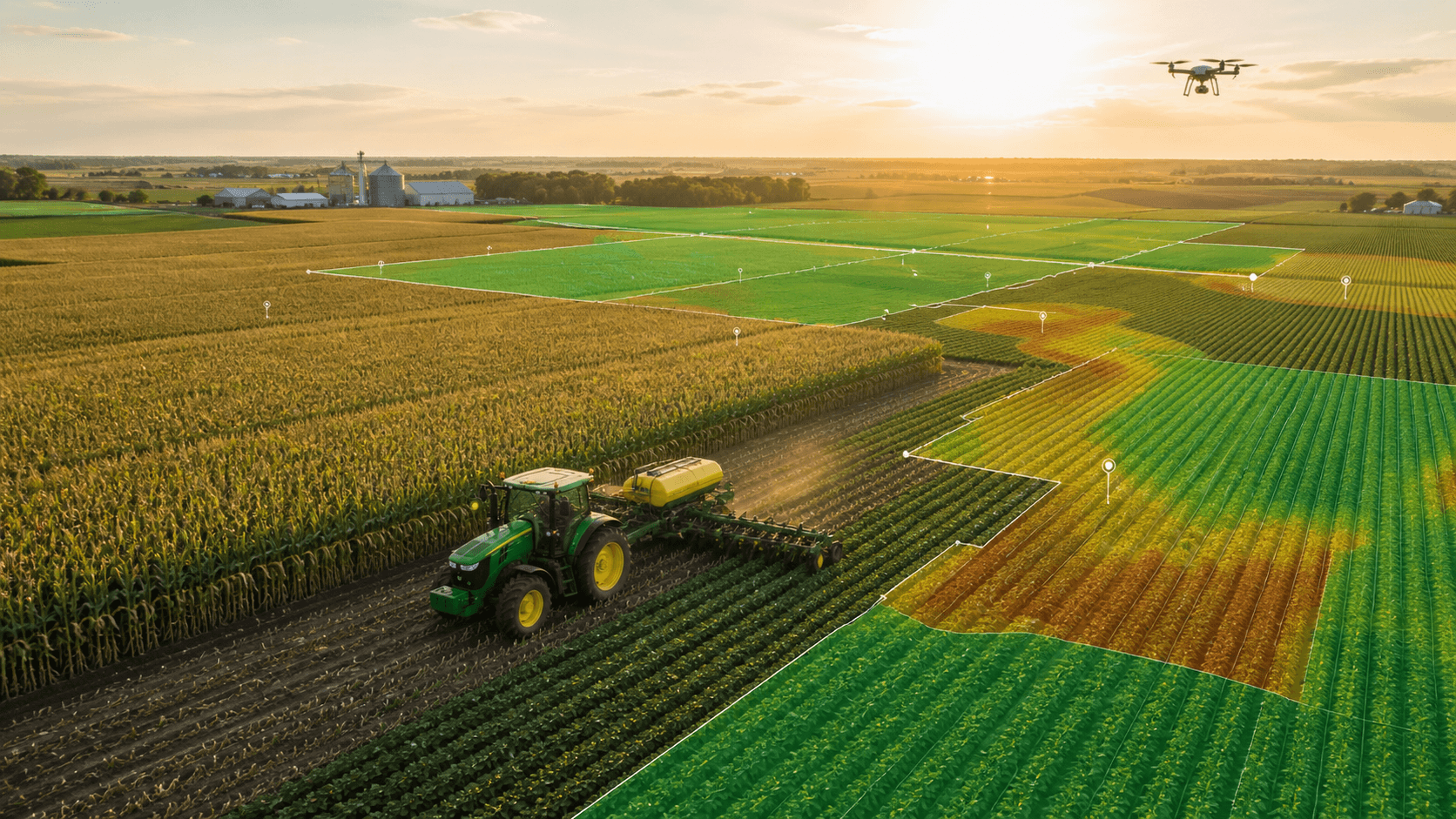
Precision farming is a data-driven management strategy that applies field inputs at variable rates based on the specific needs of each location within a field. Rather than treating a 600-acre corn field as one uniform unit, precision farming divides it into smaller management zones. Each zone gets the right seed population, fertilizer rate, and water application based on its unique soil characteristics and yield history.
This approach closes what agronomists call the “yield gap,” which is the difference between what a field actually produces and what it’s capable of producing under good management.
📊 By the Numbers: Global cereal production is projected to grow at 1.1 percent annually through 2034, driven almost entirely by higher yields rather than expanded cropland (OECD-FAO, 2025). That means farming smarter on the acres you already manage isn’t optional. It’s the primary pathway forward.
The core technologies that power precision farming include:
GPS-guided auto-steer systems that place seed and fertilizer with centimeter accuracy
Yield monitors that record bushels harvested at every point across the field
Soil EC (electrical conductivity) mapping that reveals texture, drainage, and organic matter variation
Variable rate controllers that adjust application rates automatically from a prescription map
🔍 Definition: A prescription map is a digital field map that tells your planter or applicator exactly how much to apply at each location. The equipment reads it via GPS and adjusts automatically, without the operator making manual changes.
Precision farming adoption is accelerating across the Midwest, but many producers are still capturing only a fraction of the potential benefit. The U.S. Government Accountability Office found that unlocking the full value of precision agriculture requires not just the hardware, but also the analytical systems to interpret and act on the data it generates (U.S. GAO, 2024).
How Does Variable Rate Technology Boost Yield Per Acre?
Variable Rate Technology (VRT) boosts yield per acre by precisely matching inputs to what each management zone within your field can actually support. High-potential zones get more seed to maximize ear count. Low-potential, drought-prone zones get less, which reduces plant stress and conserves moisture for the plants that survive.
The economics are compelling. Operations with high spatial variability, generally defined as greater than 10 percent yield variation across a field, see the strongest return on VRT investment. Economic analyses of VRT seeding implementations show the technology is most profitable on farms exceeding roughly 370 acres, where operational scale amplifies every efficiency gain (Source 53).
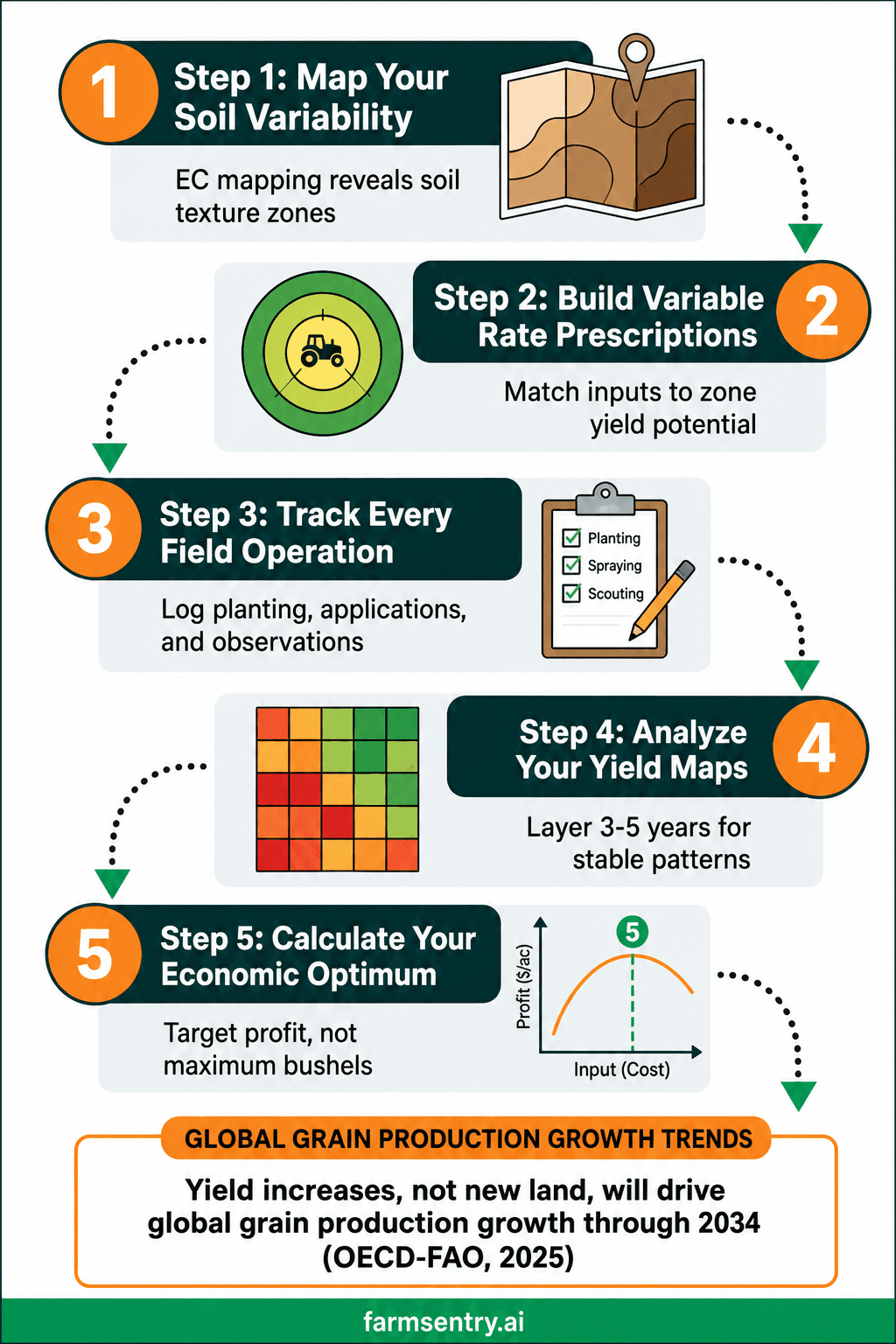
Here’s how a VRT workflow runs from start to finish:
Map the field: Conduct intensive soil EC surveys and pull zone-based soil samples to understand spatial variability.
Layer yield history: Stack three to five years of yield monitor data to identify zones that consistently over- or underperform.
Build prescriptions: Work with a certified agronomist to translate zone data into planting populations, fertility rates, and lime applications.
Execute with precision: GPS-equipped planters and spreaders follow the prescription in real time across the field.
Review and refine: Compare end-of-season yield maps against prescriptions to improve zone boundaries and rates each year.
✅ Best Practice: Don’t build management zones from a single year of yield data. One weather event can distort your entire map. Use at least three years to identify stable, recurring patterns you can act on with confidence.
⚠️ Common Mistake: Investing in precision planting equipment without investing in the soil sampling needed to write accurate prescriptions. Expensive technology guided by bad data is still bad agronomy.
Why Is Soil Health the Foundation of High Grain Yields?
Here’s the thing about soil health. Every input you apply, whether it’s seed, fertilizer, or water, has to move through the soil before it ever reaches the plant. A degraded, imbalanced, or compacted soil profile limits what any technology above ground can accomplish.
I’ve seen farms spend serious money on precision equipment while ignoring the basics below their feet. It doesn’t end well.
For Midwest corn and soybean producers, four soil health factors deserve close attention every season:
Soil pH: Keep it strictly between 6.0 and 6.5. Outside that range, nutrients bond chemically to soil particles and become unavailable to plant roots, regardless of how much fertilizer you apply.
Macronutrients (N, P, K): These drive the bulk of yield response. Nitrogen is the primary lever for corn yield. Apply based on realistic yield goals, soil organic matter content, and current soil test results, not on habit or last year’s rate.
Micronutrients: Zinc, boron, and manganese are easy to overlook on a large operation. According to Liebig’s Law of the Minimum, your crop yield is constrained by the scarcest nutrient in the system, not the most abundant one. A zinc deficiency will cap your corn yield even when nitrogen, phosphorus, and potassium are in perfect balance.
Drainage: Waterlogged soils push oxygen out of the root zone, which shuts down nutrient uptake and stunts growth. Poor drainage also triggers denitrification, a process where soil bacteria convert your applied nitrogen fertilizer into gas and release it into the atmosphere, never reaching the crop.
💡 Pro Tip: Switch from whole-field composite soil samples to grid or zone-based sampling immediately. Composite samples average out the variation that creates your biggest yield gaps. Zone samples give you a map you can act on, rather than a single number that hides what’s really happening.
How Can Data and Analytics Help You Farm More Profitably?
Data and analytics help you farm more profitably by converting raw field information into decisions you can act on before yield losses become permanent. The shift from whole-farm accounting to field-level analysis is one of the most powerful competitive advantages available to large grain operations right now.
Traditional enterprise accounting tells you how the farm performed overall after harvest. Field-level data analysis tells you which specific acres generated a profit and which ones are consistently dragging returns down. Purdue University research confirms that field-level data enables real-time, in-season interventions, allowing producers to correct nutrient deficiencies, pest pressure, and application errors before they become season-defining losses (Purdue University, 2021).
🎯 Key Takeaway: Data collection is only the first step. The real payoff comes when you use that data to write better prescriptions, catch problems during the season, and evaluate the true return on every input dollar you spend.
Tracking your field activities consistently throughout the year is just as valuable as collecting sensor data. Platforms like FarmSentry’s activity logging let you record planting populations, fertilizer applications, spray passes, and field observations in one organized system. When you can pull up exactly what happened on a specific field during a specific growing season, you make better decisions for the next one.
Knowing your true cost-per-acre matters just as much. A farm financial management system that links input costs, equipment usage, and yield data to individual fields gives you the actual profitability picture for every acre on your operation. That’s far more useful than an enterprise-wide average when making input decisions for next year.
When Should You Harvest to Protect Your Grain Yields?
Start combining corn when grain moisture reaches 20 to 25 percent. That’s the window that minimizes mechanical damage and combine losses. Waiting until the crop dries naturally in the field risks lodging, ear drop, and mold development that can cost you serious bushels before the combine ever enters the field.
Harvest timing is your last chance to protect the yield you built all season. Don’t waste it.
Here are the key rules for each major Midwest grain crop:
Corn: Start combining at 20 to 25 percent grain moisture. Adjust rotor speed, concave clearance, and fan settings throughout each day as moisture levels change across your fields.
Soybeans: Target 13 to 14 percent moisture. Too early and pods shatter aggressively. Too late and seeds crack during threshing, causing dockage at the elevator.
Post-harvest storage: Dry corn to below 14 percent moisture before placing it in long-term storage. Manage bin aeration continuously. Uneven temperatures inside a full bin create moisture migration, which leads to mold growth, mycotoxin development, and rapid quality loss.
⚠️ Common Mistake: Setting combine adjustments once at the start of harvest and never revisiting them. Crop conditions, moisture levels, and stalk integrity change throughout each day and differ across fields. What works at 8 a.m. on one field may be cracking grain by 2 p.m. on another.
What Is the Difference Between Maximum and Optimum Grain Yield?
Let’s be honest about something most agronomic publications gloss over. The biological maximum yield and the economic optimum yield are not the same number. And chasing the biological maximum almost always costs more than it returns.
The economic optimum yield is the output level that produces the highest net profit after all input costs. Every input you apply follows the law of diminishing marginal returns. The first 80 pounds of nitrogen per acre on corn produces a large yield response. The next 20 pounds produces a smaller response. The pounds after that produce progressively less. At some point, the cost of the next pound of nitrogen exceeds the value of the grain it produces.
📊 By the Numbers: Research shows that applying nitrogen to reach the absolute biological maximum in corn may require significantly higher rates than the rate at which marginal return equals marginal cost. Chasing that final few bushels per acre costs more than the grain is worth at most price levels.
The economic optimum shifts every season based on input prices and commodity prices. Running this math before each planting decision, and adjusting prescriptions accordingly, is one of the most direct ways to protect your bottom line when markets are volatile.
Your FarmSentry dashboard puts real-time input cost data, weather trends, and farm-level KPIs in one place. When nitrogen prices spike or corn futures shift, you can revisit your prescriptions quickly and make adjustments grounded in current economics rather than last season’s assumptions.
Conclusion and Action Plan
Maximizing grain crop yields with precision farming isn't about buying every new piece of technology available. It's about using better data to make sharper decisions at the moments that matter most throughout the growing season.
Key Takeaways:
Precision farming and variable rate technology reduce input waste and concentrate resources where your fields can actually convert them into grain.
Soil health, including pH management, nutrient balance, micronutrient sufficiency, and drainage, sets the absolute ceiling on what any precision tool can achieve.
The economic optimum yield, not the biological maximum, is the target. Know the difference before you write a single prescription this season.
Your Next Steps:
1. Pull zone-based soil samples from every field this fall. Build your management zones using EC mapping and multi-year yield history before next planting season.
2. Calculate your true economic optimum nitrogen rate for corn using current fertilizer costs and projected corn prices. Adjust your prescription accordingly.
3. Set up a digital system to log every field operation consistently. Consistent records are the data layer that makes every other precision tool more valuable.
4. Review this season's yield maps and identify the three zones on your operation that consistently underperform despite adequate inputs. Investigate the root cause in each one before spring.
Shareable Insight: "The farms that close the yield gap fastest are not the ones with the most technology. They are the ones making better decisions with the data they already have."
3. U.S. Government Accountability Office. (2024). Precision Agriculture: Benefits and Challenges for Technology Adoption and Use. U.S. GAO. Available at: https://www.gao.gov/products/gao-24-105962 [Accessed: 18 April 2026].
4. Author Unknown. (2022). Variable rate seeding in precision agriculture: recent advances. Agriculture, 12(2), 305. Available at: https://www.mdpi.com/2077-0472/12/2/305 [Accessed: 18 April 2026].